
The Hard Part May Come After Part 107: Helping Drone Pilots Build a Business
Amy Wiegand’s new AeroRev Co-Pilot aims to address a familiar challenge in the commercial drone industry: turning aviation skills into sustainable revenue.
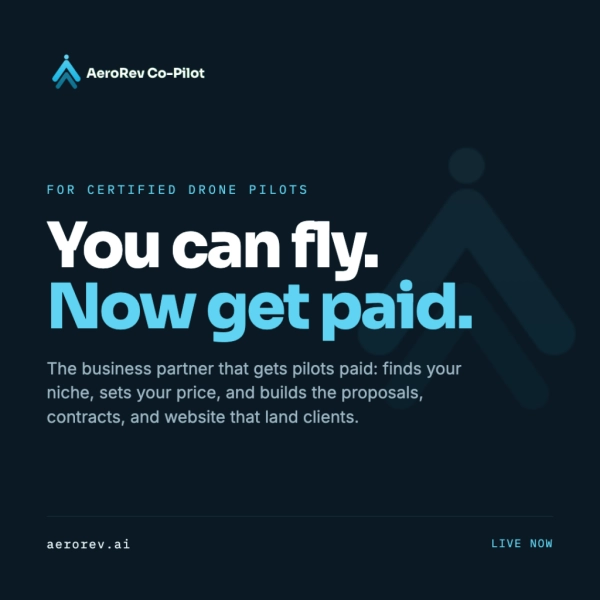
Earning a Part 107 Remote Pilot Certificate gives commercial drone operators the credentials they need to get started. It does not tell them what to charge, which customers to pursue, or how to turn a technical skill into a sustainable business.
“I get a lot of feedback on the need to understand how to build and grow this business, and most newly certified pilots stall on the business side,” Wiegand told DRONELIFE. “They buy equipment before validating a market, quote jobs below true cost, create poor marketing, and struggle to turn one-off gigs into sustainable revenue.”
Wiegand has now launched The AeroRev Co-Pilot, a business development platform designed specifically for certified commercial drone pilots.
The idea is straightforward: flight training teaches pilots how to operate an aircraft. AeroRev focuses on what comes next.
From Certification to Customers
The challenge is particularly relevant for solo operators and small drone service providers. A new pilot may know how to plan and execute a mission, but running a business requires a different set of decisions.
Which services are worth offering? Is there enough demand in the local market? What does a job actually cost to perform? How should it be priced? What does a professional proposal look like? And how does an operator move from individual projects to repeatable work?
AeroRev is designed to guide pilots through those questions in stages, covering market selection, customer discovery, capabilities and compliance, service design and pricing, marketing, operations, and market entry.
Importantly, Wiegand says the program is not another flight-training course.
“It doesn’t teach you how to fly,” she said. “It helps you decide which market to serve, set defensible pricing, and produce the real deliverables that close deals.”
Those deliverables include a niche and market scorecard, cost model and price book, proposal and contract materials, a website, and a compliance checklist. Client-facing documents go through a human approval step before they can be sent.
The program also takes a results-based approach to progress.
“You don’t advance by watching content,” Wiegand said. “You level up when your numbers and deliverables work.”
Building Around Real Commercial Drone Work

Amy Wiegand
Wiegand says the platform draws on input from working drone service providers rather than relying only on general business theory.
That includes collaboration with Jared Janacek, founder of TexasDroneCo, who has contributed experience from commercial operations to the platform’s pricing logic and practical guidance.
“I’ve flown the jobs and sent the invoices, and the mistakes are almost always business mistakes, not flying mistakes,” Janacek said in the launch announcement. “The Co-Pilot is the partner I wish I’d had when I started.”
That distinction gets to the central problem AeroRev is trying to solve. Becoming a capable pilot and becoming a successful drone service provider are related goals, but they require different skills.
Wiegand brings more than 30 years of experience in growth, operations, sales, and marketing to the project. Her work in unmanned aviation began while she was running a flight school in Virginia. In 2016, she says, the school became the first to facilitate a formal small UAS training program for the State of Virginia. She has also advised on aviation technologies including Unmanned Traffic Management and Advanced Air Mobility.
Testing a Path From Pilot to Business Owner
AeroRev was introduced earlier this year through Commercial UAV Expo‘s Innovation Spotlight. The September 1 launch opens the beta and public waitlist as Wiegand continues to test and refine the model.
Pilots can begin with a complimentary “Discovery Flight,” a self-guided, audio-based consultation that takes about 40 minutes. It evaluates where the operator’s business currently stands and produces a readiness report and recommended path. No credit card is required. Pilots can then join the waitlist for the upcoming Essentials and Advisory offerings.
Wiegand says the goal is to measure whether the process can help operators move more quickly from certification to consistent, paid work.
For an industry that has invested heavily in aircraft, sensors, training, and certification, the business side of commercial drone operations can receive less attention. Yet for independent pilots and small service providers, technical capability only becomes a business when customers are willing to pay enough for the work to make it sustainable.
“Certification gets pilots in the air,” Wiegand said. “We wanted to give them a practical co-pilot that helps them choose the right niche, price with confidence, and turn skills into profitable, professional operations.”