
BETA Technologies, Metro Aviation and Washington County EMS test how electric aviation could support disaster response and medical operations in Texas
BETA Technologies and Metro Aviation have completed an electric aircraft demonstration with Washington County Emergency Medical Services in Brenham, Texas. The flight explored how electric aviation could support emergency response in rural areas.
The companies flew BETA’s all-electric ALIA conventional takeoff and landing (CTOL) aircraft during the September demonstration. The test focused on moving disaster-response equipment as part of an existing emergency medical system.
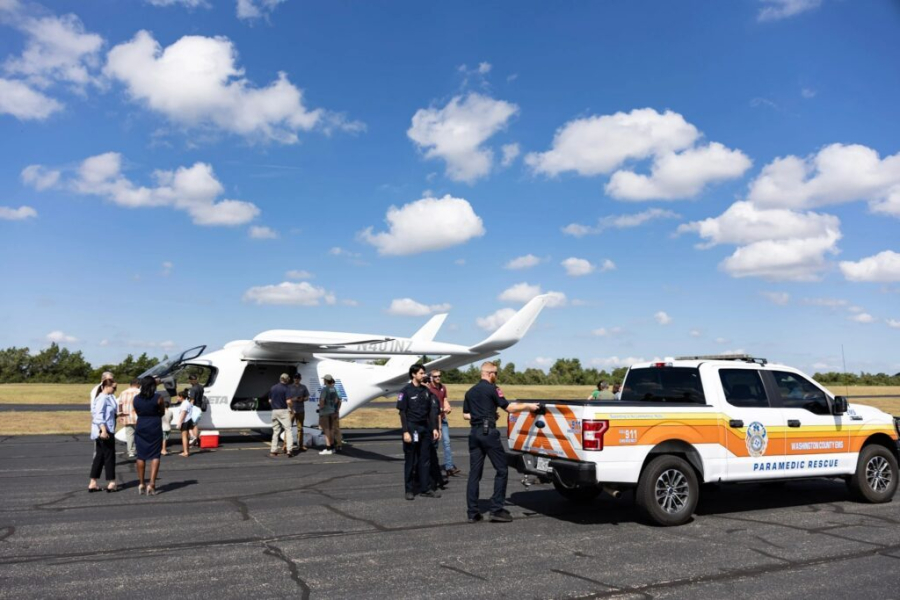
Washington County EMS responds to more than 7,000 calls each year across roughly 700 square miles. Its service area includes the Brazos River and Lake Somerville. The agency provides emergency and non-emergency transfers, critical care and rescue paramedic services.
“Washington County EMS is incredibly grateful to be partnered with Metro, and have the ability to contribute to this project,” said Washington County EMS Director Taylor Leonard.
Metro Aviation has worked with Washington County EMS since June 2022. Metro currently operates an EC145 helicopter for the county as part of its emergency medical system.
Testing Electric Aircraft Alongside Existing EMS Operations
Rather than replacing the county’s helicopter or ground vehicles, the demonstration examined how electric aircraft could add another transportation option.
The ALIA CTOL moved disaster-response equipment alongside Washington County’s existing emergency response resources. The demonstration gave local officials and EMS leaders a chance to consider where electric aircraft might fit into future operations.
“In Brenham, we saw what we’ve only been able to talk about finally come to life,” said Todd Stanberry, vice president at Metro Aviation. “We partnered with BETA over three years ago, knowing without hesitation that Kyle Clark and his team created the solution the air medical industry has needed for a long time: a more affordable aircraft. We have been so fortunate to have Washington County EMS and the rest of the Metro family involved every step of the way since then, and now, through the eIPP, they got to see the art of the possible become reality.”
Metro’s longer-term interest in BETA extends beyond the CTOL aircraft demonstrated in Texas. In 2024, Metro placed a deposit-backed order for up to 20 ALIA VTOL aircraft. The air medical operator plans to integrate the vertical takeoff aircraft into its fleet for potential inter-hospital and scene transports.
The Texas demonstration therefore represents one part of a broader effort to understand where electric aircraft could fit within established medical aviation operations.
Part of a Larger Texas Integration Program
The Brenham flight marked BETA’s first Texas operation under the U.S. Department of Transportation and FAA eVTOL Integration Pilot Program, or eIPP. It also forms part of Project Nexus, an initiative led by the Texas Department of Transportation.
Through Project Nexus, BETA and Metro are evaluating electric aircraft operations along a route connecting Galveston, Sugar Land and Brenham. BETA already has a Charge Cube electric aircraft charging station operating in Galveston.
“Project Nexus is a whole-of-ecosystem effort to build the operating model required to bring electric aviation into routine commercial service across the state of Texas,” said Simon Newitt, head of sales and support at BETA Technologies. “Through the program, BETA is working alongside established aviation operators, public agencies and mission partners to evaluate how electric aircraft and charging infrastructure can integrate into their existing operations. Our work with Metro Aviation and Washington County EMS applies that model to an essential public service and helps build a repeatable path to expand access to critical services for Texans.”
The demonstration did not establish a new commercial EMS service. Instead, it tested how electric aircraft, charging infrastructure and existing emergency-response systems could work together.
For rural EMS agencies, that integration may be especially significant. Large service areas can require moving equipment, supplies and personnel across long distances. Electric aircraft could eventually provide another option between ground transportation and traditional air medical aircraft.
The Texas program will help operators and public agencies gather practical experience before electric aircraft become a routine part of emergency medical aviation.