
ETH Zurich Engineers Collision-Resilient Flexible Drone
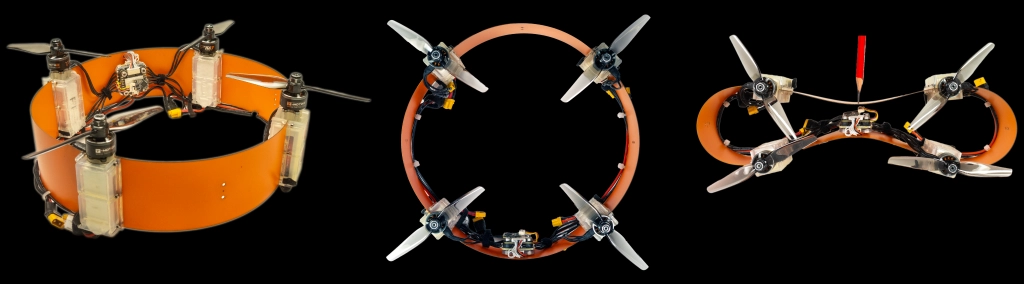
This novel FlexiQuad architecture aims to boost performance in tight quarters, rescue efforts, and tough terrains.
A team at ETH Zurich has engineered a drone that keeps flying even after hitting obstacles. Such a capability would be valuable in settings where dodging every hazard is hard or not feasible.
Unlike standard quadcopters with rigid bodies, FlexiQuad features a flexible, ring-like frame. Upon impact, this frame flexes to absorb energy, which lessens the force of the crash and helps maintain flight stability.
Tests show the drone can survive impacts at roughly 25 kilometers per hour (16 mph). In regular flight conditions, it can achieve speeds reaching 80 kilometers per hour (50 mph).
This project offers an alternative safety strategy. Rather than depending solely on sensors to steer clear of hazards, the drone relies on its physical structure to cushion collisions.
A Flexible Design Inspired by Nature
Luca Girardi and Stefano Mintchev created FlexiQuad at ETH Zurich’s Environmental Robotics Lab. Girardi has since moved to the university’s Mobile Robotics Lab, while Mintchev is now at the University of Bonn.
The design mimics biological wings, which bend in specific directions while staying rigid in others, a trait seen in birds and insects.
Mirroring this biological principle, the drone’s frame bends laterally upon impact but stays vertically stiff to support lift. The rotors, batteries, and controls are mounted along the ring, removing the need for a central fuselage.
"Our drone is very agile and can fly at speeds of up to 80 km/h. It reaches linear and angular accelerations comparable to those of rigid drones. Soft doesn’t automatically mean slow," said Girardi.
A patent application has been submitted for this design. Additionally, ETH Zurich has put forward the invention for its 2026 Spark Award.
Potential Applications in Inspection, Rescue, and Counter-Drone Operations
This flexible structure may provide benefits for drones navigating crowded or narrow areas.
Use cases range from inspecting ship ballast tanks and searching rubble for survivors to gathering data in thick forests. Since the frame can deform, a larger drone might squeeze through gaps narrower than its usual width. This flexibility allows for bigger aircraft with more sensors or longer battery life to access tight spaces.
The team also tested the drone’s manipulation skills. It successfully picked up, carried, and dropped a soft first-aid kit, and even lifted a load exceeding its own weight.
Another idea involves counter-drone tactics. Girardi proposes fitting a net inside the hollow center to snag rogue drones, though this is still a concept rather than a proven capability.
The design may also mitigate damage from unexpected crashes during fast maneuvers.
"When a mission requires a drone to cover long distances quickly, a drone is supposed to fly fast, but its sensors may detect obstacles – such as a tree – too late to avoid a collision. For a rigid drone, such an impact can end the mission. FlexiQuad’s ability to withstand collisions could allow it to fly at speeds that would be too risky for a drone that relies entirely on detecting and avoiding obstacles" Girardi explains.
Challenges Before Commercial Deployment
Currently a research prototype, FlexiQuad faces technical hurdles before it can function reliably outside the lab.
Post-collision vibrations are a concern. While the frame absorbs the initial shock, it may continue to shake, potentially blurring camera footage and disrupting navigation. To solve this, the team is using reinforcement learning, a type of AI, to help the drone stabilize using onboard sensors and resume autonomous flight.
Researchers are also exploring if frame movements can aid flight control. The structure is inexpensive, with materials costing under 15 Swiss francs according to ETH Zurich. It can also fold compactly for easy transport.
Although still in early development, the study suggests flexible structures could work alongside traditional avoidance systems.
In commercial settings, this method could boost reliability in collision-prone areas. Future drones might not need to dodge every object but could instead endure minor impacts and keep working.
Source: ETH Zurich, November 3, 2026. New Flexible Drone Can Withstand Collisions