
Agri Spray Targets Domestic Drone Production Amid Federal Restrictions
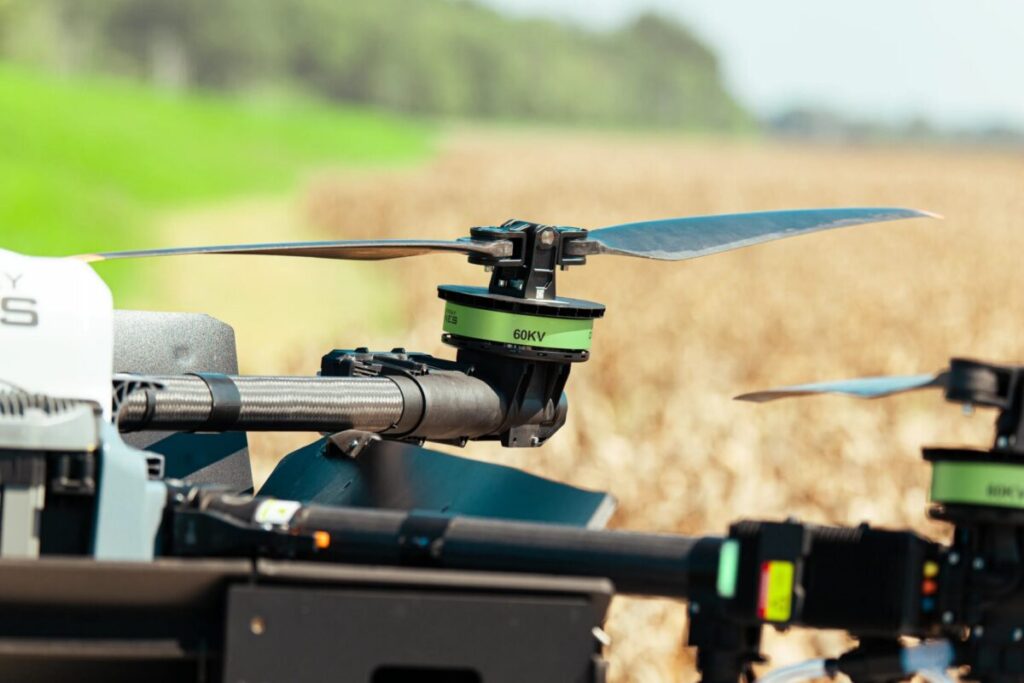
A Missouri-based firm specializing in agricultural drones has unveiled a five-year roadmap designed to eliminate reliance on foreign parts and establish a homegrown supply chain.
by DRONELIFE Features Editor Jim Magil
Boonville, Missouri-headquartered Agri Spray is pivoting its business model in response to a changing regulatory landscape for foreign-made UAVs. The company announced it will transition from distributing Chinese-made products to manufacturing fully American-sourced agricultural drones within a five-year timeframe.
Agri Spray founder and CEO Taylor Moreland explained in an interview that the dramatic shift in business strategy was triggered by restrictions imposed by the Federal Communications Commission (FCC) and the U.S. Department of War (DoW). These regulatory moves have generated a substantial demand for domestically developed and manufactured agricultural spray drones.
"We’ve been working on this for a little over a year, putting the plans together to get an understanding of what the needs are to begin producing some of this technology in the U.S.," he said.
Over recent years, multiple federal branches have restricted the import and use of drones and components from nations deemed hostile to the US, with China being the primary focus. In July, the FCC proposed limiting foreign-produced drones and critical components that appear on the FCC’s Covered List and satisfy its proposed definition of "military-grade."
This definition covers drones that are capable of dispensing "economic poison," a capability that could apply to agricultural spray drones used for distributing insecticides and defoliants.
Moreland stated that Agri Spray would overhaul its entire business strategy to ensure it remains a competitive entity in the U.S. market for the foreseeable future, driven by these new restrictions.
"We will be beginning to manufacture and build the R&D and engineering side of the house to actually develop the technology in the US to meet the government regulations and to keep up the supply of this highly needed equipment," he said.
Given the magnitude of the undertaking, the company anticipates that the conversion process will span several years.
"Could we build a 100 percent US-made spray-drone: software, hardware, everything? Yes, we could. But could we build 5,000 of them by the end of this year or next year? No," he said. He noted that the U.S. currently lacks the capacity to provide the agricultural drone industry with essential components, particularly motors and batteries, needed to manufacture fully American-produced drones at the necessary scale.
Moreland indicated that the company intends to launch the initial phase of its five-year plan as early as this month, starting with the in-house production of software.
"Our software team has been built up over the past several months and we’re actually building our own software and firmware for these drones, even though much of the hardware is still coming from China," he said. "We’ll be utilizing the DoW and FCC’s conditional approval program so that we can continue to use existing foreign supply chains while we onshore components over the next five years."
Despite this shift, the company will continue to use foreign-sourced components for the flight controller and printed circuit board, which are manufactured in allied nations like Taiwan.
According to Moreland, the federal government’s crackdown on foreign-made drones and components is driven by two main concerns: data security and supply chain security.
"The U.S. government wants to make sure that the drones flying over U.S. skies are controlled — software-wise, data-wise, backend-wise — by U.S. companies. And secondly, they want to make sure that the supply chain cannot be cut off by one foreign adversary or another."
5-year transition plan
The hardware side of the transition will begin with assembly, which is scheduled to start within the next few months. Agri Spray will assemble drones using mostly foreign components at its headquarters in Missouri, where a section of the main warehouse has been converted into an assembly line.
"Assembly and quality control are the first steps that are happening at our headquarters in Missouri," Moreland said. "We’re prototyping multiple different hardware components from several different manufacturers across the country."
During the second and third years of the transition, Agri Spray will gradually increase the proportion of U.S.-made components used in its products.
"That’ll start with a lot of the simpler items, some injection-molded pieces, some aluminum tubes for the frame, some different fasteners," he said. "Then the most complicated piece of that – for US components — will be the PCB boards."
By the fourth year, the company aims to have established a robust supply chain sufficient to begin installing U.S.-sourced motors into its drones.
"We are starting to prototype those now. We know that building that steady supply is going to take a bit of time, so it’s not going to be an instant switch," he said. The company plans to start prototyping U.S.-made batteries next year, with the goal of installing them in most products by year four. By year five, Agri Spray expects to satisfy U.S. government requirements regarding U.S. production and componentry.
Moreland noted that the transition will require a significant increase in staffing for the small company, which currently has a workforce of about 65 people. "Over the next two years we will likely be hiring about 25 to 30 people."
To fund its planned expansion, Agri Spray, which is currently 100 percent owned by Moreland, plans to seek outside financing. "We are right now beginning the first steps into seeking investment. We’re being pretty strategic about who we work with. We want to work with folks who are just as passionate as we are about this industry," Moreland said.
Focus on agricultural drones
Founded in 2020, Agri Spray has averaged the production of 1,000 agricultural spray drones per year over the past three years. Moreland stated that the company concentrates exclusively on the agricultural market segment.
"We’re really not doing camera drones, mapping drones, enterprise drones. So, it’s just spray drones, along with all the accessories, the batteries and chargers, but also the field equipment."
Due to the rigorous demands placed on spray drones, a significant portion of Agri Spray’s business involves providing parts, repair services, and technical support. Operating agricultural drones in the field typically requires extensive support infrastructure, including large generators, trailer systems, plumbing systems, and replacement parts.
"Spray drones are used, 10 plus hours a day, every day, all summer long at very high weights, at very close proximity to the ground and power lines and trees," Moreland said. "More accidents happen with spray drones and it’s much more critical to get them up in the air extremely fast because you’re racing against the clock in terms of weather and plant growth and disease growth."