
Robinson’s “Era of Both” Expands from Tactical Drones to Heavy-Lift UAS
Full-size unmanned helicopter demonstrates deck landings and cargo operations as Robinson shows off range: from small tactical drones to heavy-lift autonomous aircraft
Robinson Unmanned is emerging as a significant participant in the growing U.S. unmanned defense and logistics sector. Now, the company is demonstrating how that strategy extends well beyond small drones.
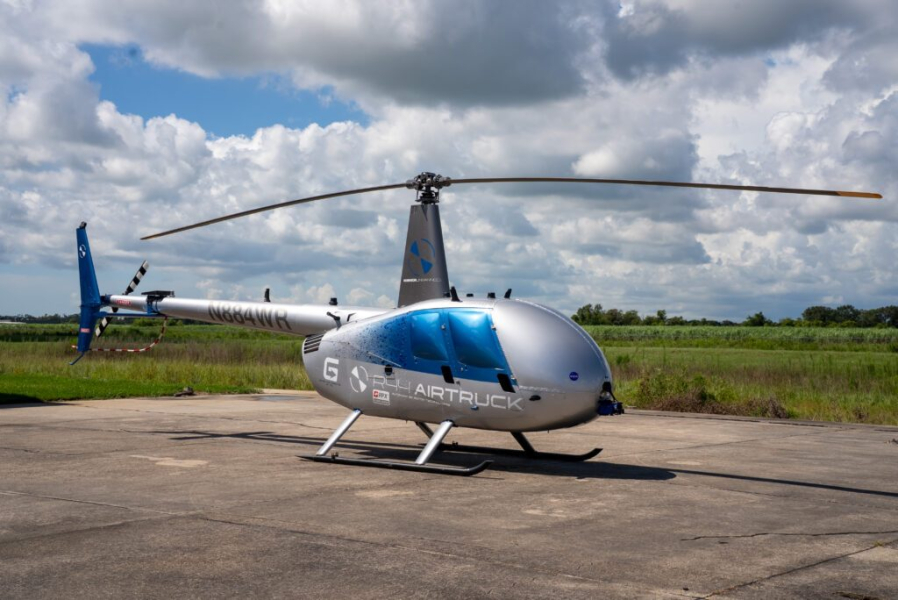
Last week, the Robinson Unmanned R44 AIRTRUCK completed two days of demonstration flights at Acadiana Regional Airport in New Iberia, Louisiana. The remotely piloted cargo helicopter performed repeated approaches and landings on a platform configured to represent an offshore deck.
The September 2 and 3 demonstrations were conducted by Aviation Academy of Louisiana (AAL), an authorized Robinson dealer and service center. PHI Aviation joined invited industry and government observers at the event.
The aircraft demonstrated cargo loading and unloading, elevated deck landings, precision positioning and airspace integration. Operations used a two-person crew consisting of a remote pilot in command and one ground support crew member.
For Robinson Unmanned, the demonstration represents another step in a much broader expansion of its uncrewed aircraft business.
From Small Tactical Drones to Full-Size Helicopters
Robinson Helicopter Company established Robinson Unmanned earlier this year, bringing the small UAS portfolio developed by Ascent AeroSystems together with larger uncrewed aircraft based on Robinson’s R44 and R66 helicopters.
Ascent AeroSystems, acquired by Robinson in 2024, is now part of the broader Robinson Unmanned organization. The resulting portfolio stretches from the sub-250-gram HELIUS through the SPIRIT and SPARTAN coaxial platforms to the R44 AIRTRUCK, R44 SPRAYHAWK and R66 TURBINETRUCK.
That range is increasingly relevant to defense and civil customers alike. Robinson Unmanned has advanced in the Pentagon’s Drone Dominance Program. The company was invited to participate in Gauntlet II while continuing Phase One deliveries of its U.S.-made SPIRIT-FPV systems.
The program is designed not only to identify capable and secure systems, but also to develop a U.S. industrial base capable of manufacturing drones rapidly and at scale.
The R44 AIRTRUCK represents the other end of that portfolio.
Rather than a small tactical system, AIRTRUCK is based on Robinson’s widely deployed R44 helicopter. Rotor Technologies’ RPX unmanned flight system adapts the aircraft for remotely piloted operations. The aircraft has a useful load of up to 1,000 pounds, more than 60 cubic feet of internal cargo volume, a cruise speed above 100 knots and an operating altitude of up to 14,000 feet.
Robinson describes the platform as a heavy-lift UAS for cargo transport, logistics and resupply. Importantly, it retains commonality with the production R44, allowing operators to draw on an established ecosystem of parts, maintenance practices and support infrastructure.
Testing a Real-World Offshore Mission
Louisiana offered a particularly relevant environment for demonstrating that concept.
The state’s aviation industry has decades of experience supporting offshore energy operations in the Gulf. Those missions require aircraft to move people, equipment and supplies to platforms in challenging operating conditions.
For an unmanned system, the potential value proposition is straightforward: send cargo without placing a flight crew aboard the aircraft during higher-risk missions.
“This is the Era of Both in practice, the same airframe, the same parts, and the same people supporting manned or unmanned missions,” said David Smith, president and CEO of Robinson Helicopter Company. “Offshore operators have spent decades moving crews and cargo to platforms in some of the toughest flying conditions there are. When you build an unmanned aircraft on a proven helicopter, they don’t trade away reliability to gain autonomy. They get both, and they get to send the aircraft, not the crew, on the highest-risk legs offshore without giving up the load or the capability they have come to count on from Robinson.”
The Louisiana demonstration also tested another element of Robinson’s strategy: whether an unmanned aircraft derived from a conventional helicopter can fit into existing aviation support infrastructure.
AAL operates flight training, a Part 145 repair station, Part 91 operations and other aviation services at Acadiana Regional Airport. Its existing Robinson fleet and the AIRTRUCK can use the same support infrastructure.
“Louisiana has been supplying offshore platforms since 1947, and companies like PHI have been doing the hard part almost as long. If an aircraft like this is going to carry part of that load, it must land on a deck and it must be maintainable here. Louisiana is where you find that out,” said Beau Prine, General Manager of Aviation Academy of Louisiana.
The “Era of Both”
Robinson calls its broader strategy the “Era of Both,” describing a future in which crewed and uncrewed aircraft operate as complementary tools rather than competing technologies. The company says its goal is to build an integrated vertical-flight ecosystem that can scale across aircraft sizes and mission requirements.
That approach also leverages something relatively unusual in the drone sector: an existing high-volume helicopter manufacturing and sustainment operation.
Robinson’s acquisition of Ascent addressed one of the persistent challenges facing U.S. drone manufacturers: moving from promising aircraft designs to repeatable production at scale. Ascent gained access to Robinson’s established vertically integrated manufacturing infrastructure in Torrance, California.
The Louisiana demonstration illustrates the same idea at the larger end of the aircraft spectrum. Instead of developing an entirely new heavy-lift drone and then building a manufacturing, maintenance and support network around it, Robinson is adapting an aircraft that already has those systems in place.
That could matter across both commercial and defense markets.
For offshore operators, the immediate opportunity is moving substantial cargo while reducing human exposure during hazardous flights. For defense users, similar capabilities could support logistics and resupply missions where sending crews creates unnecessary risk.
Robinson Unmanned’s growing portfolio therefore tells a larger story. The common thread is not simply autonomy. It is an effort to combine autonomy with aircraft, manufacturing processes, maintenance infrastructure and supply chains that already exist.
As the unmanned sector moves from demonstrations toward larger-scale deployment, that infrastructure may prove as important as the technology that removes the pilot from the cockpit.
}