
From Cars to Drones: Birdstop Leverages Detroit’s Auto Supply Chain to Scale U.S. Manufacturing
UAV maker turns to auto industry as source of domestic components
While Silicon Valley is well-known as a mecca for the launch of flashy high-tech firms, and Detroit as the home of the older, more staid and much less exciting automotive industry, for one autonomous security drone startup the move from the former area to the latter made perfect sense.
In an interview with DRONELIFE, Keith Miao, CEO of Birdstop, a manufacturer of UAV systems used in infrastructure monitoring and security, said the company’s moved from the San Francisco Bay Area late last year to take advantage of the opportunities Detroit presented for rapidly scaling up the production of new drone systems.
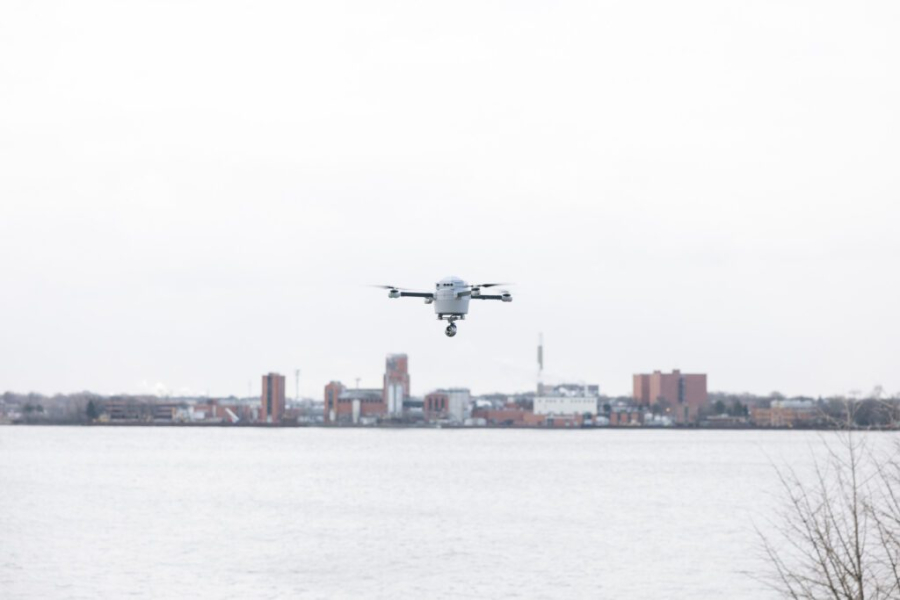
With much of the U.S.-based manufacturing of electronics components and related products migrating overseas over the past decades, because of the demand from Detroit’s auto industry, the city and surrounding region have endured as one of few hubs for securing those products from U.S.-based suppliers, he said.
“There aren’t many electronics-based products that are produced at a very high volume in the United States. And when we looked around the automotive industry, it is one that still has a really large scale,” he said. “We still make over 10 million cars a year domestically.”
Many, if not most of those vehicles manufactured in the Detroit area are built in large part using components that are manufactured and distributed the United States. For example, the Ford F50s built in nearby Dearborn, use between 70% and 80% domestically sourced components, Miao said.
He noted that there is a surprising overlap between the types of components that go into the manufacture of autos and those used to build drones.
“The drones that we build are small sensor-carrying drones. They operate generally at under 400 feet altitude. They generally operate at a very low altitude and at a pretty low speed, between 40 and 60 miles per hour,” Miao said.
In other words, drones operate in atmospheric conditions and at speeds that are closer to those of a passenger car or pickup truck than a supersonic aircraft.
“The kind of specs and the requirements and sorts of testing that go into these components actually overlap very well with the types of testing requirements that we need for our drone components,” Miao said. “Most of the other drone makers are heavily dependent on aerospace and defense supply chains, which are quite expensive but also, generally (produced at) lower volumes.”
Company introduces Fealty system
Birdstop produces artificial intelligence-aided autonomous systems, which are used to provide reconnaissance and security for private entities and governmental facilities. The company recently introduced as its new flagship product, the Fealty system, which it began deploying in May to monitor truck parking sites across Detroit.
Miao said the Fealty system is different from anything the company has built before and is probably different from “anything that anyone in the drone industry has built before.” The Fealty system features a weatherproof, autonomous quadcopter designed for persistent site coverage.
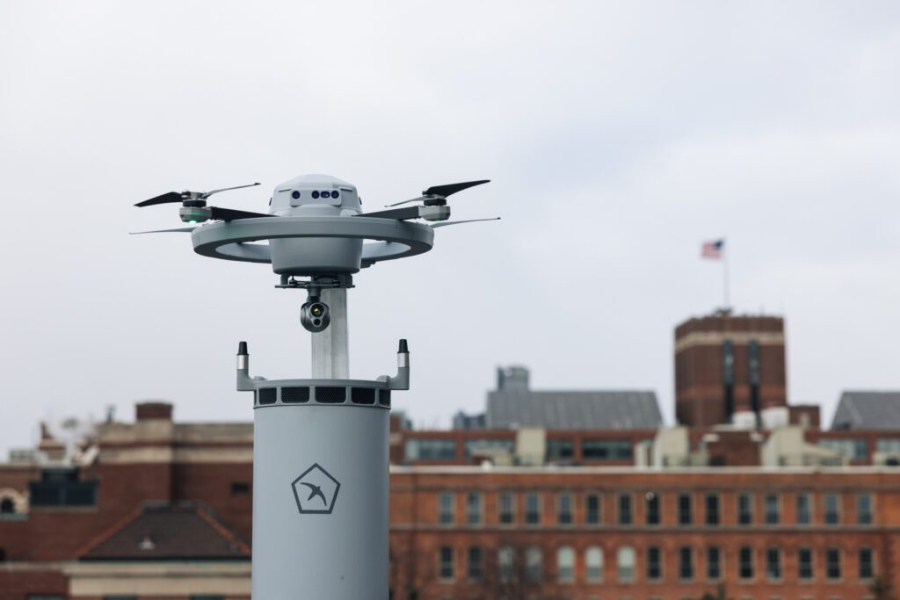
The UAV is housed in a weatherproof shelter, which serves as charging dock and sensor mast in one unit. The unit allows the drone to be ready to launch on command and charge on contact when it lands.
On-board AI software provides real-time detection, classification and dispatch, while a single operator can run multiple systems from a single console.
“It’s a system that sits out in field on a perch and it deploys a drone on the top of the perch. In three seconds, it’s up in the air, at 60 miles per hour responding to an incident, whether that incident is a safety incident or whether that’s a 911 call or whether that’s a breach-of-perimeter alarm,” he said.
Focus on domestic drone manufacturing
Miao said backed by its strong domestic supply chain and with a rapidly growing demand for its products and services, he foresees a robust growth in the company’s manufacturing output over the next several years.
“It’s the first year of production for Fealty and it’s in the hundreds. Next year it’s in the thousands, and then the next year after that, the tens of thousands,” he said. He added that he expects Birdstop will be able to grow its production volumes by roughly one order of magnitude every year for the next four to five years.
“And at that point, I think that once we get to the hundreds of thousands, the millions (of units) per year of production, then I think that’s where we’re able to satiate demand for this technology fully from domestic production,” he said.
As an American drone producer, Miao said he is very supportive of the steps that the federal government has taken to encourage the growth of the domestic UAV industry.
“Having been in the industry for a while, we obviously recognize how critical drone technology is to national security, to critical infrastructure, in both civilian and military use cases,” he said.
“I think that we feel relieved that the general public and the federal government have recognized the importance of this technology, whether it’s changing the face of modern warfare as we’ve seen over the last several years now, or it’s being part of life-saving operations domestically as we’ve seen being used by first responders and emergency services.”
He cited some of the recent actions that various branches of the federal government have taken to restrict the use in the U.S. of foreign-made drones and components, such as the FCC restrictions that affect products produced in countries identified as adversaries and the more recently announced imposition of tariffs on imports, even from some nations deemed as America’s allies.
The concerted set of federal policies is likely to have the desired effect of incentivizing the domestic drone producing industry, he said.
“I think it is starting to show effect, and I think in two or three years, it’s very possible that we’ll have a strong domestic drone manufacturing capacity. I think that is nothing is guaranteed, but I think that is very, very likely.”