
Doodle Labs Introduces Nano² Radio for Long-Range FPV Drone Communications
The lightweight Nano² radio supports high-quality video, interference avoidance and networked operations for military and commercial users
When selecting a radio control system for their vehicles, drone manufacturers face the challenge of balancing the need for a robust system with all the capabilities to fulfill the UAV’s mission, against installing a radio small and light enough to provide the minimum amount of drag on the drone’s flight.
This dilemma is particularly vexing for builders of small unmanned aerial systems, such as first-person-view (FPV) drones prized by military and civilian users alike, where every extra gram of weight counts. Seeking to address the tradeoff between a system with full capabilities and a minimal form factor, Marina del Rey, California-based Doodle Labs recently introduced its Nano² radio.
“We work in hardware and there is a saying in the hardware space that ‘hardware is hard.’ And it’s definitely true,” Amol Parikh, Doodle Labs co-CEO, said in an interview. “Shrinking things down can often come at the sacrifice of capabilities, of certain types of connectors, ease of integration, things like that.”
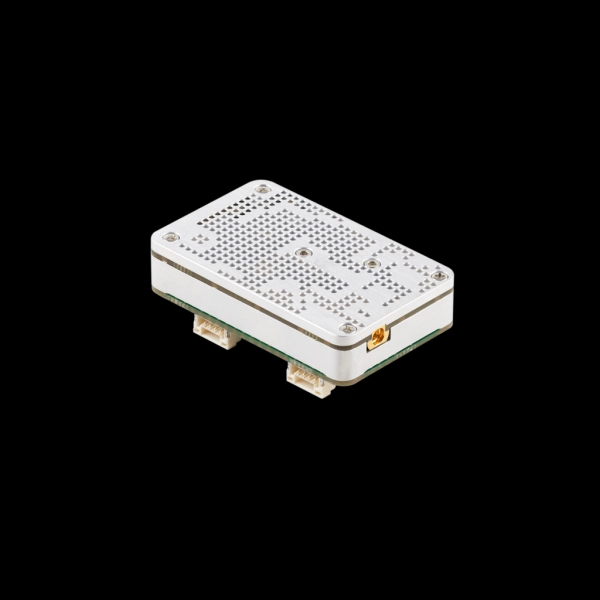
Weighing in at 48.3 grams, the Nano² packs a 2×2 multiple-input multiple-output (MIMO) capability into nearly the same footprint as the company’s original Nano radio, while keeping features such as cross-band frequency agility and self-healing mesh networking.
“Here at Doodle Labs, we design and manufacture high-performance long-range and resilience connectivity solutions, and we really specialize in robotics and drones in particular,” Parikh said. He added that the size, weight and power consumption (commonly known as SWaP) of Doodle Labs’ radios “is very fit-for-purpose for these aerial platforms.”
With radio systems designed to provide high throughput for high-fidelity video at extremely long ranges, Doodle Labs’ products are adaptable for both military and commercial applications, he said.
On the defense side, the company and a close partner have been selected to take part in the Pentagon’s Drone Dominance campaign, with Doodle Labs preparing its industrial-grade mesh radios to be deployed as a core communications backbone for the program.
Doodle Labs’ relationship with the U.S. military goes back several years, with its first production of the Mini Mesh Rider Radio, a compact mobile ad-hoc network router designed for drone and robotics original equipment manufacturers. Developed for the U.S. Army under the sponsorship of the Defense Department’s Defense Innovation Unit (DIU), the Mini has served as the core of Doodle Labs’ technology stack.
“Our radio that we were able to develop for them covers multiple frequency bands, which is really hard to do in a small package, and it provides that long-range, highly reliable connectivity,” Parikh said. “And actually, a lot of the development that we bring in is now on the software and capability side, building off of these really small radios.”
Meanwhile, the company also remains dedicated to marketing its products to commercial as well as military customers. “We are also squarely dual-use. We have a commercial background, and we take that as a core of who we are, and we still support a lot of opportunities on the commercial side,” Parikh said.
Operating in contested environments
In developing its radio systems for the military, Doodle Labs has focused on designing products that allow the user to operate in adverse conditions and contested environments. Communication systems for small FPV drones have traditionally been running on analog connectivity, or sometimes on fiber-optic systems, both of which have their own advantages and drawbacks.
“There’s a real trade-off in sticking with analog,” he said. If an adversary knows the frequency at which the drone is communicating with its operator, the signal can be easily intercepted or jammed. “When you think about the highly critical and confidential information that is being transmitted from these drones in actual contested environments, that’s a real trade-off.”
Because of these challenges, many drone operators have switched to the kind of digital-based connectivity solutions, which Doodle Labs specializes in. “It’ll also allow you to expand into larger swarms over a mesh, getting higher fidelity, higher quality video and being able to be transmitted with greater throughput capabilities.”
Recently, company officials realized that by creating a miniaturized version of the highly capable radio systems, they could help ease the transition to digital communications for producers of small FPV drones.
“A lot of these FPV platforms have these standardized frames that they use, and so they have space limitations that are actually predesignated,” Parikh said. “What we actually were able to do is re-architect our Mini and create it so that it had a smaller footprint, a smaller X and Y footprint to be able to better sit on that rail plate. We were able to do that in a way that we didn’t have to sacrifice any of the capabilities that we have.”
Commercial use case challenges
Commercial drone users face many of the same connectivity issues as those seen on the battlefield. Parikh said the company has engineered its Sense software product to address these challenges. Sense offers an advanced interference-avoidance technology, designed to be used in combination with Doodle Labs’ multi-band Mesh Rider Radios.
“What we’re really doing is taking advantage of the fact that we house multiple frequency bands in every radio. We hold more range of spectrum per radio than any other digital radio supplier,” he said.
Under FCC regulations, commercial drone operators are only authorized to use a limited number of unlicensed radio frequencies for their communications. Crowded frequency bands can result in a great deal of interference for drone operators, especially those flying within busy urban environments.
However, employing the Sense technology allows the operator to navigate as much as possible within a single frequency band.
“One of those is the Wi-Fi band at 2.4 gigahertz,” he said. “There’s also 900 megahertz and 2.4 gigahertz and 5.8 gigahertz, which all now give us more optionality. We have different radios available in all of those, and we have one radio that covers both 900 megahertz and 2.4 gigahertz.”
The environment in which drone users operate is rapidly changing, with the withdrawal of DJI products from large swaths of the market, and new regulations from the FAA and FCC coming on the horizon, Parikh said.
“We see from our vantage point, that the technology is definitely developing very rapidly, but while we face active contested situations in defense use cases, the passive interference that you face on the commercial side is a significant challenge to deal with as well.”