
Avidrone Achieves 3.84:1 Ratio in DARPA Heavy-Lift Drone Challenge
DARPA Lift Challenge winner achieves a 3.84:1 payload-to-weight ratio with a purpose-built 29-pound aircraft
By DRONELIFE Features Editor Jim Magill
A Canadian drone company has won a contest sponsored by a U.S. Department of Defense agency, by almost reaching a milestone that’s been compared to the first human breaking a supposed physical barrier by running a four-minute mile.
An aircraft, designed by Breslau, Ontario-based Avidrone Aerospace demonstrated an unprecedented payload-to-weight ratio for heavy-lift drones at the DARPA Lift Challenge held at the National Museum of the U.S. Air Force in Dayton, Ohio on August 9. The winning entry earned Avidrone, which also has a U.S. headquarters in Columbia, Maryland, a first-place prize of $1.25 million.
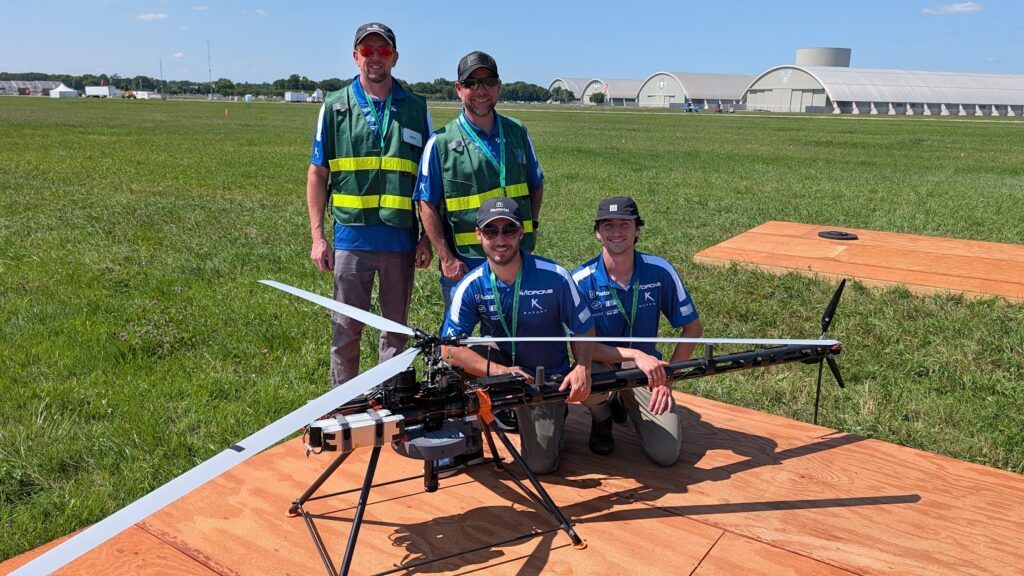
The competition, which attracted a broad field of U.S.-based and international UAS producers, challenged teams to build a drone weighing 55 pounds or less capable of lifting a payload equal to four times the drone’s weight and carrying it over a fixed, five-mile course. Many aviation experts had considered setting expectations for such a payload-to-drone weight ratio to be an impossible goal to achieve, similar to the way the four-minute mile was once viewed.
Avidrone’s vehicle came close, with payload-to-weight ratio of 3.84:1. In a statement, DARPA said while the results did not achieve the Challenge’s ultimate goal of achieving a 4:1 ratio, they still represented a success, showing that the benchmark, once thought impossible to reach now seems to be within reach of today’s technology.
“It’s a very high bar. The 4:1 lift ratio was really the main metric in the game,” Scott Gray, Avidrone’s founder and CEO, said in an interview. He added that no drone, and to his knowledge no manned aircraft, has come close to achieving that standard.
“We had to lighten everything, to take mass away from every part of the system,” he said. In addition to the vehicle being able to lift the required payload, the Challenge required skilled drone pilots to accurately maneuver their drones along the precise course set up by DARPA. “Otherwise you were disqualified or your run would not count,” he said.
At first, Avidrone engineers thought they could enter a version of one of their existing heavy-lift vehicles, one that employed a tandem-rotor design, similar to that of a Chinook helicopter. But as they studied the requirements and the rules, they decided to totally redesign their original model, transforming it into a single-rotor aircraft.
“The single rotor was largely based on our history of large rotorcraft drones. We have special proprietary rotor blades and rotor-head design, transmission design and of course, the autopilot,” Gray said. The redesign resulted in the creation of a 29-pound purpose-built aircraft capable of lifting 112-115 pounds of payload.
Gray said Avidrone views the company’s Challenge vehicle as a prototype and plans to continue working on the design, with the possible commercialization of the drone as early as next year.
Focus on heavy-lift aerial vehicles
Incorporated in 2007, Avidrone was initially focused on research and development in the field of radio-controlled helicopters, aircraft and power systems.
“Over time, I turned the company’s focus to include software and hardware design and mechanical design to where we are today, which is a full end-to-end solution provider,” Gray said. As an original equipment manufacturer (OEM) of cargo drones and intelligence, surveillance and reconnaissance (ISR) surveillance UAVs, Avidrone has specialized in the design and production of heavy-lift aerial vehicles.
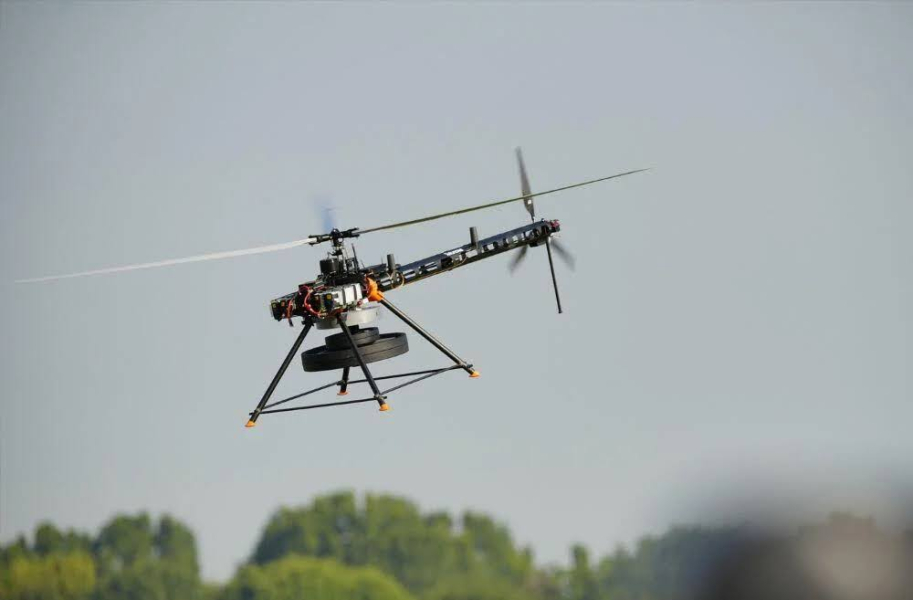
“We’ve done aircraft as large as almost 1,000 pounds gross weight that were automated rotorcraft,” he said.
Gray said that the company’s key differentiator in the international heavy-lift drone market has been the development of its proprietary autopilot system. “We’re not using autopilots that are off-the-shelf or open-source.”
With offices in both Ontario and Maryland, Avidrone is able to service markets in both Canada and the U.S. as well as international markets for heavy-lift UAVs. Trade-related issues and global concerns over secure supply chains have made accessing international markets a little more challenging in recent months.
“Selling these types of products has become a little more difficult with supply-chain changes,” Gray said. “All of our systems are NDAA-compliant, meaning we source a lot of the components from domestic and friendly vendors. That’s really important to note.”
Lift Challenge attracts many international players
Avidrone was not the only non-U.S. team to compete in the Lift Challenge. Teams from 25 countries were among the 480 teams that initially applied to take part in the competition.
International participation in the Challenge was limited by only two factors. Companies based in countries deemed by the Department of Defense to pose high security risks were ineligible to participate in the competition, and the Challenge’s rules required that the leader of each team had to be an American, or in the case of corporate teams, an American-based company.
In a recent call with members of the press, Philip Smith, DARPA program manager in charge of the competition, said the Challenge’s requirements were designed to make the Challenge as open as possible, in order to attract potential entrants from a broad cross-section of the UAV industry.
“We wanted to see the innovations from around the world. We wanted to bring all of that to America to compete,” he said.
In addition, the Challenge organizers said they hoped the competition would encourage international drone players to bring their expertise in heavy-lift technology to American shores.
“You can see our competitor list, and we had Australians, we had South Africans, we had Austrians. We had a number of different companies and all of them, or most of them, I think, are in the process now of saying, ‘Okay, we want to build a business in America where you have these types of opportunities.’”
Lift Challenge organizers hope that the competition will encourage aviation industry players to take the next step in designing the next generation of vertical-lift technology.
“We’ve had fixed-wing aviation, where we’ve been limited by runways and all the infrastructure that is required. If we make that next step to vertical-lift aviation, we see entirely new markets being opened, enabled by this technology,” Smith said.