
Skyfly Secures $10 Million to Launch Personal eVTOL Aircraft
UK developer targets private ownership under new FAA light-sport rules while expanding into unmanned defense applications.
UK-based Skyfly Technologies has secured $10 million to bring its two-seat Axe electric aircraft into commercial production. The aircraft combines vertical takeoff capability with fixed-wing flight, targeting private owners rather than commercial air taxi operators.
HICO Investment Group led the seed round, with participation from defense technology investor Archangel.
Skyfly plans to use the funding to complete FAA light-sport certification and expand manufacturing capacity in the UK and US. The company expects its first customer deliveries in 2027. The investment follows more than 100 prototype flights and experimental flight permits in both countries. Skyfly reports an order book of 61 private customers worldwide.
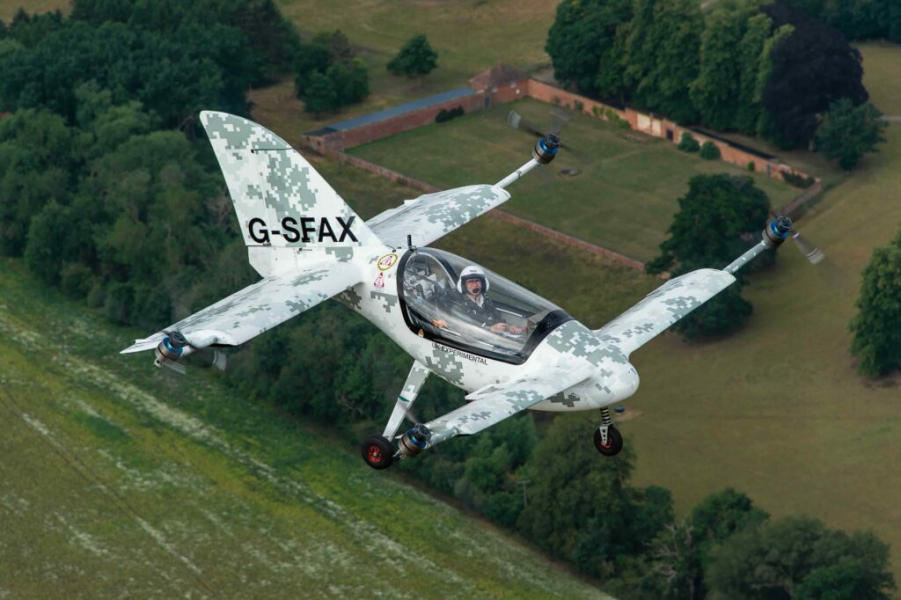
New FAA Rules Open a Path for Personal eVTOL Aircraft
The FAA‘s Modernization of Special Airworthiness Certification (MOSAIC) framework, which took effect in July 2026, expands eligibility for light-sport aircraft.
The updated rules accommodate electric propulsion, multiple motors, and certain aircraft with vertical takeoff capabilities. They create a potential certification path for aircraft designed for private ownership rather than commercial passenger service.
Skyfly designed the Axe with this market in mind.
“The FAA’s MOSAIC rules have opened a route to market that simply did not exist for electric aircraft before, and the Axe was designed for exactly this category,” said Michael Thompson, CEO of Skyfly.
The company must still demonstrate compliance with applicable requirements before it can deliver certified aircraft.
Combining Vertical Takeoff With Fixed-Wing Efficiency
The Axe uses eight fixed-angle electric motors for vertical takeoff and landing. Once airborne, its fixed wings provide lift during forward flight, reducing the energy required for cruising.
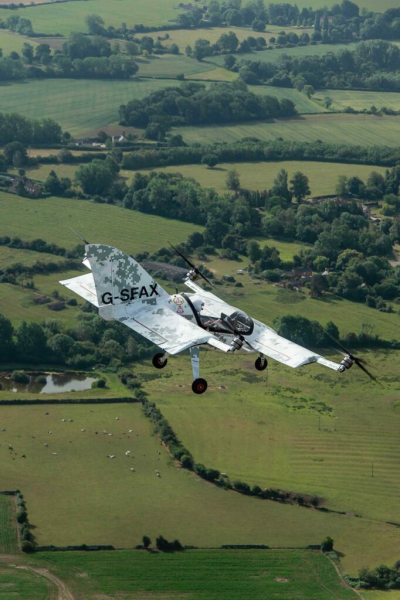
Unlike designs that use tilting motors or rotating wings, the Axe has no moving transition mechanisms. Skyfly says this simplifies the aircraft and reduces maintenance needs.
According to the company, the Axe offers a range exceeding 100 miles, flight endurance of 60 to 90 minutes, and a cruise speed of approximately 100 mph. It has a stated payload capacity of 200 kilograms.
Skyfly estimates operating costs at approximately $90 per flight hour, substantially below those of many conventional light aircraft. These figures remain company projections rather than independently verified operating results.
The Axe can take off vertically without a runway but can also use conventional runways when available.
The company demonstrated the prototype at EAA AirVenture Oshkosh in 2025 and 2026. It also reports completing an airfield-to-airfield eVTOL flight in Europe.
Technology Also Targets Unmanned Defense Missions
Skyfly is applying its aircraft design to the Longbow, a hybrid-electric unmanned aircraft for defense and government customers.
The company is targeting a range exceeding 400 miles and a payload capacity of 200 kilograms. Proposed applications include cargo resupply, intelligence and surveillance, medical evacuation, and ship-to-shore logistics.
Skyfly says it has joined the UK Ministry of Defence’s heavy-lift challenge.
“Longbow addresses a clear requirement for unmanned systems that can move meaningful payloads over significant distances without relying on a runway,” said Nicholas Nelson, General Partner at Archangel Ventures.
The Longbow remains in development, with no announced delivery schedule.
From Prototype to Customer Deliveries
Skyfly operates a 10,000-square-foot manufacturing and assembly facility in the UK. The new investment will support production expansion and continued development of its hybrid-electric technology.
The Axe represents a different approach to the emerging eVTOL market. Rather than focusing on commercial air taxi services, Skyfly aims to offer vertical flight to individual aircraft owners.
Whether that market develops at scale will depend on certification, operating costs, pilot requirements, and customer demand.
For now, the funding gives Skyfly additional resources to move beyond prototype testing toward its planned 2027 deliveries.