
Airspeeder Partners with Advanced Navigation to Test Precision Systems in Electric Flying Car Racing
A new technology partnership aims to improve precision navigation, flight control and collision avoidance under demanding flight conditions.
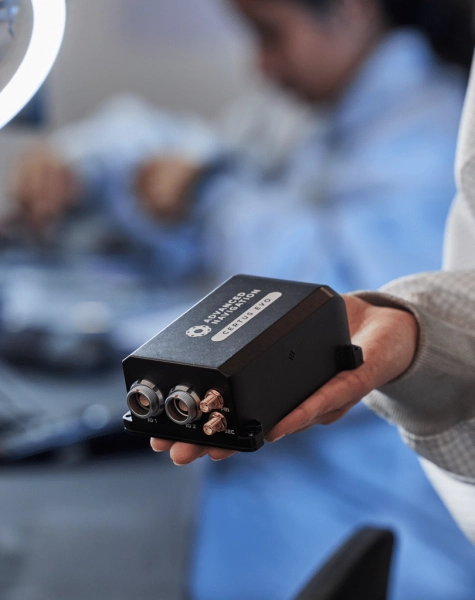
Advanced Navigation technology supports precise positioning and flight control in demanding flight environments.
Airspeeder has named Advanced Navigation as the official navigation partner of its international electric flying car racing series. The companies announced the partnership on November 23 in Adelaide, South Australia.
The collaboration will bring precision navigation technology to high-speed electric flight. It also offers an opportunity to test systems that could benefit commercial drones and autonomous aircraft.
Bringing Precision Navigation to Flying Car Racing
Airspeeder’s racing series combines electric aviation, motorsport and augmented reality (AR). Pilots remotely control full-size electric vertical takeoff and landing (eVTOL) aircraft above motorsport circuits. They follow digital racecourses overlaid onto real-world environments using AR technology.
The Airspeeder Mk3 features eight rotors, a lightweight carbon fiber chassis and a 96 kW electric powertrain. The aircraft can reach speeds exceeding 120 kilometers per hour (75 mph).
High-speed turns, rapid acceleration and sudden changes in altitude place significant demands on navigation systems. Advanced Navigation will equip the Mk3 with sensors that provide real-time data on aircraft position, speed and orientation.
The technology aims to improve flight control and support collision avoidance during close-quarters racing.
“Airspeeder exists to push advanced air mobility systems to their limits,” said Matt Pearson, CEO and co-founder of Airspeeder.
The navigation systems could also provide pilots and ground crews with more detailed performance data. For spectators, the technology could support three-dimensional aircraft tracking and virtual cockpit views.
Applications Beyond the Racetrack
For the commercial drone industry, the partnership’s significance extends beyond competitive racing.
The joint technology program will allow engineers to evaluate navigation performance under demanding flight conditions. Engineers will also refine the software that combines data from multiple sensors to improve positioning accuracy.
“Airspeeder is creating a flying laboratory for technology uses beyond motorsport,” said Chris Shaw, CEO and co-founder of Advanced Navigation.
Potential applications include high-speed fixed-wing drones, electric cargo aircraft, autonomous helicopters and tiltrotors. Research could also support aircraft navigation in environments where GPS signals are unavailable or unreliable.
Reliable positioning and collision avoidance remain important technical challenges as the commercial drone industry moves toward more complex autonomous operations. Competitive racing offers another environment in which developers can test and refine these capabilities.
According to the announcement, Airspeeder’s inaugural race will take place in Adelaide in November 2026. Five pilots will represent Australia, the United States, Great Britain, Italy and New Zealand. The second race will follow in April 2027.


