
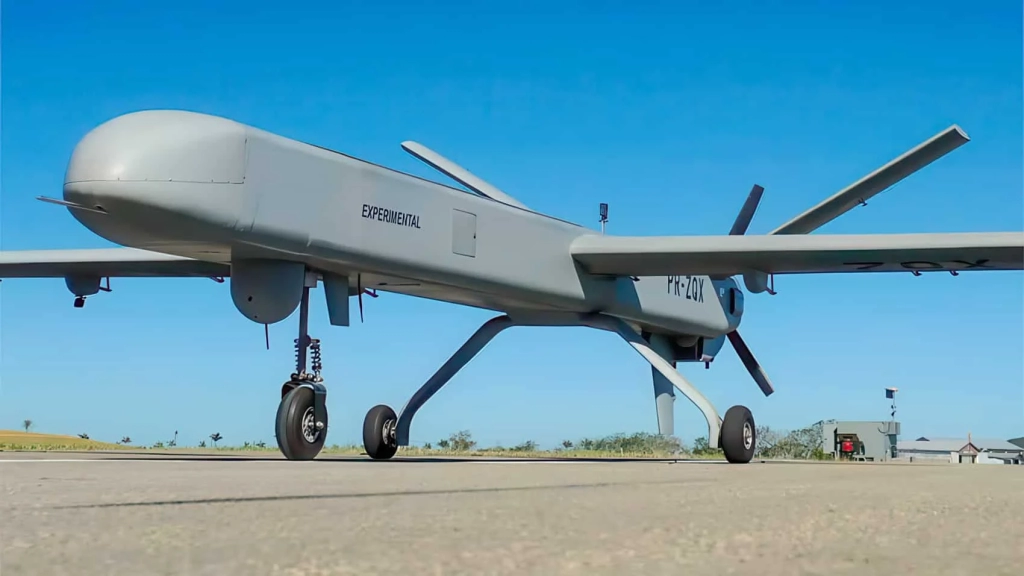
 Photo credit: Stella Tecnologia
Check out the Best Deals on Amazon for DJI Drones today!
Brazil is not just playing fútbol, nor buying drones. It is building them at home.
On February 5, the Brazilian Air Force signed a new protocol of intention with Stella Tecnologia, expanding a relationship that has been quietly maturing since a memorandum of understanding in September 2023, as JANES reports.
This new agreement runs for 60 months, with the option to extend, and sets the stage for deeper technical collaboration in unmanned systems.
The focus is broad and ambitious. Intelligence, surveillance, and reconnaissance. Search and rescue. Cargo transport. Attack roles. Airborne communications nodes. In other words, Brazil wants UAVs that can watch, relay, carry, and, if required, strike.
Stella’s president, Gilberto Buffara Júnior, said the partnership will move beyond studies and into joint development, including an ISR platform equipped with BVLOS datalink capability and a next generation gyrostabilized electro optical multisensor turret powered by artificial intelligence.
That combination signals something important. The aircraft is only half the story. The data pipe and the sensor brain are the real prize.
Condor leads the charge
If there is a flagship in Stella’s hangar, it is the Condor MALE UAV.
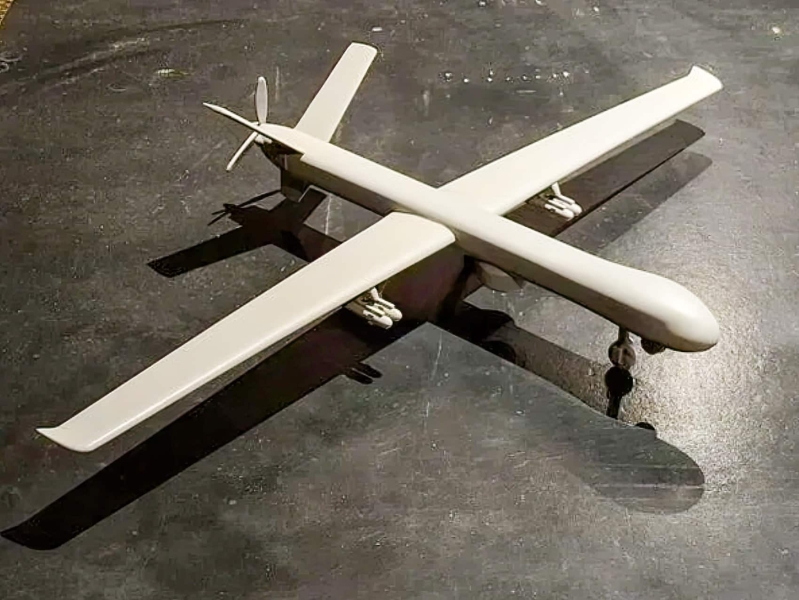 Photo credit: Stella Tecnologia
The Condor is designed as a high intensity, multi domain platform with serious lifting power. A 55-foot wingspan. A 36-foot fuselage. A 160 HP gasoline engine. Maximum takeoff weight of 3,086 lbs. Endurance officially listed at up to 40 hours. Ceiling at 23,000 feet. Cruise speed around 100 knots.
But the real headline is payload. Up to 771 lbs.
That is enough to carry a front mounted electro optical or SAR gimbal up to 165 lbs, plus underbelly radar, plus wing mounted mission kits. In practical terms, this allows the Condor to shift from maritime patrol to electronic warfare to armed overwatch with modular swaps rather than structural redesign.
With dual datalinks, radio up to 155 miles and satellite for global reach, plus a triple redundant flight control computer capable of autonomous takeoff and landing, the Condor is clearly aimed at strategic persistence. It is built to stay aloft, collect, relay, and remain relevant in contested airspace.
Atobá and Albatroz fill the spectrum
Below the Condor sits the Atobá MALE system. Eight meters long. Eleven meter wingspan. Maximum endurance of 28 hours with a lighter payload. MTOW between 1102 and 1542 lbs. Ceiling around 16,000 feet.
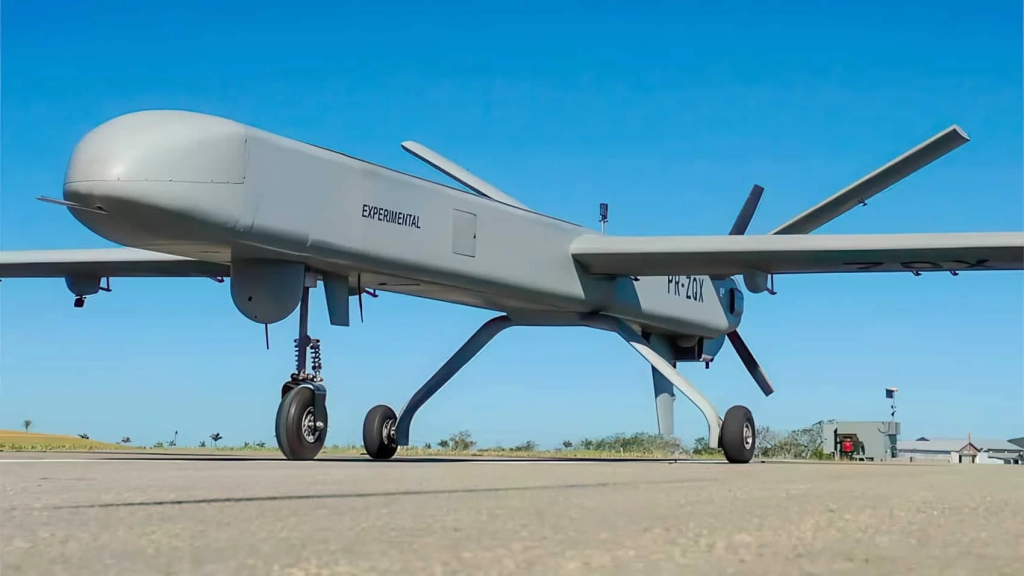 Photo credit: Stella Tecnologia
The Atobá supports up to 330 lbs of payload, depending on configuration, and offers secure dual datalinks similar to the Condor. It is positioned as a tactical and strategic ISR and attack asset, a flexible middleweight that can stay up nearly a full day while carrying gimbal mounted sensors or fuselage integrated systems.
Then comes the Albatroz, the tactical workhorse. Thirteen feet long. Twenty two feet wingspan. Payload between 11 and 66 lbs. Endurance up to 24 hours. Ceiling around 3,000 meters. MTOW of 330 lbs.
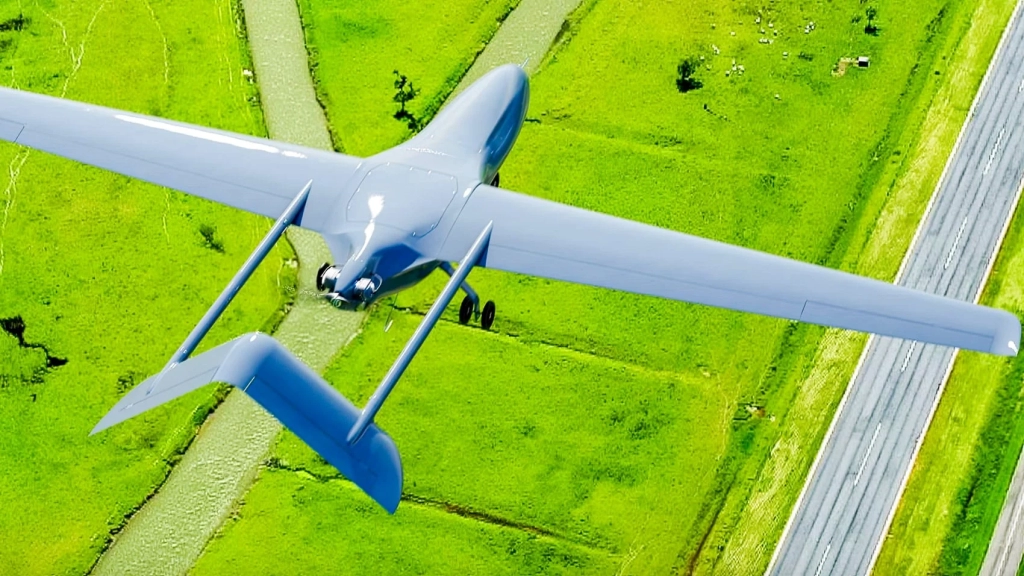 Photo credit: Stella Tecnologia
The Albatroz is designed for persistent ISR, target acquisition, and maritime domain awareness. Its modular architecture supports EO IR sensors, SAR, EW suites, and communications relay systems.
With a ruggedized ground control station capable of multi aircraft management and command handover, it fits neatly into distributed operations.
Think of the trio as a ladder. Albatroz for tactical persistence. Atobá for extended regional reach. Condor for high endurance, high payload, strategic overwatch.
A sovereign UAV ecosystem
What makes this partnership significant is not just the hardware. It is the ecosystem.
Brazil is clearly aiming for sovereign capability in UAV design, integration, and C4ISR infrastructure. Secure datalinks, satellite connectivity, autonomous flight control, scalable ground control stations, and AI enhanced sensor suites are not bolt on accessories. They are core enablers of modern air power.
By formalizing collaboration between the Brazilian Air Force and Stella Tecnologia, the country is signaling that domestic industry will not just assemble components, but co-develop mission critical systems tailored to national requirements.
Drone programs are often measured in wingspan and endurance figures. The real metric here is industrial independence.
DroneXL’s Take
Brazil is playing the long game. Instead of rushing to import fully formed MALE platforms, it is nurturing a homegrown stack from airframe to datalink to AI sensor fusion.
The Condor, Atobá, and Albatroz show a clear architectural logic across payload classes, and the new 60-month agreement suggests the Brazilian Air Force wants more than aircraft. It wants control of the roadmap. In a world where unmanned systems are evolving at software speed, that may be the most strategic payload of all.
Photo credit: Stella Tecnologia