
FAA Reverses Decision on Drone Flight Restrictions Near Federal Operations
FAA Rescinds Controversial Drone Flight Restrictions
By DRONELIFE Features Editor Jim Magill
The Federal Aviation Administration (FAA) has rescinded its previous threat to impose criminal penalties on drone operators flying near federal law enforcement vehicles. This decision follows a lawsuit filed by a journalism rights group challenging the agency’s flight restrictions.
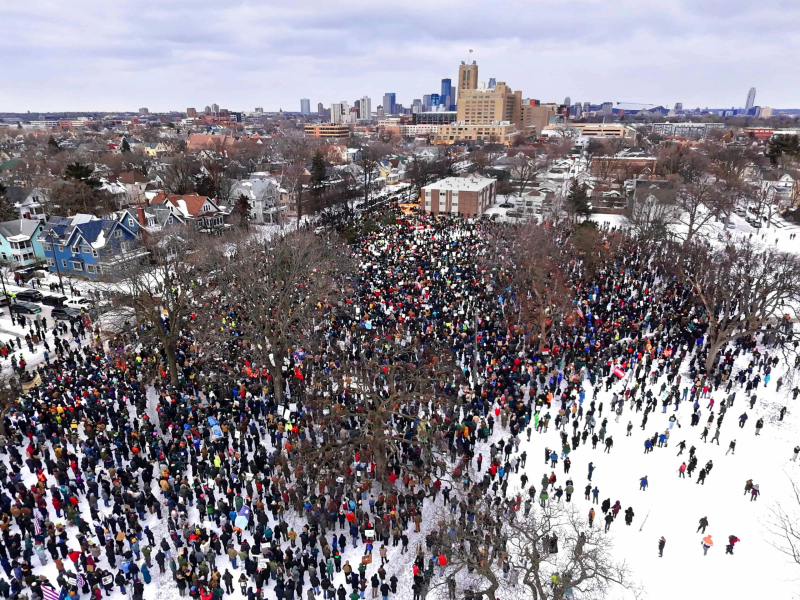
Image credit: Reporters Committee for Freedom of the Press, taken by Rob Levine of a demonstration in Minneapolis.
Details of the Rescinded NOTAM
On Wednesday, the FAA issued an advisory that revoked the controversial NOTAM FDC 6/4375. This NOTAM had prohibited unmanned aircraft from flying within a lateral distance of 3,000 feet and 1,000 feet vertically from vehicles belonging to the Department of Defense (DOD), Department of Energy (DOE), and Department of Homeland Security (DHS).
The original NOTAM, issued in January, included penalties for drone pilots found in violation, including the potential for federal criminal prosecution and FAA administrative actions, such as civil penalties and revocation of operating certificates.
New Advisory and Implications
The new advisory replaces the specific flight restrictions with a recommendation for drone pilots to “exercise caution when flying in proximity” to federal agencies’ mobile assets. While the threat of criminal prosecution has been removed, the advisory warns that federal agencies may take action against unmanned aircraft deemed to pose a credible safety or security threat.
Reactions to the FAA’s Decision
An attorney for the Reporters Committee for the Freedom of the Press (RCFP), which filed the lawsuit against the FAA, described the regulatory change as a significant victory. Attorney Grayson Clary stated, “We’re glad to see the FAA rescind its original order, which was an egregious overreach that had serious consequences for reporters nationwide.”
Last month, RCFP filed a lawsuit in the U.S. Court of Appeals for the District of Columbia on behalf of Minnesota photojournalist Rob Levine, arguing that the original NOTAM restricted his rights to use his drone for documenting immigration protests in Minneapolis.
Ongoing Legal Proceedings
On April 9, Clary filed a motion in the case requesting the court to stay the provision of the Temporary Flight Restriction (TFR) governing DHS ground vehicles while the case is pending. The motion asserted that the original NOTAM created a “grave chilling effect on the lawful use of drones.”
A spokesman for the FAA declined to comment on whether the decision to amend the flight restrictions was influenced by the ongoing litigation. He stated, “The FAA cancelled NOTAM 6/4375 and replaced it with NOTAM 6/2824 to clarify drone operations based on user feedback.”
Levine expressed relief at the FAA’s actions, stating, “It was heartbreaking to have my drones grounded at a time of such importance to my community, but I’m looking forward to getting back up there and getting back to my journalism as soon as possible.”
Clary noted that while the FAA’s amendment is a step forward, it does not fully address the issues raised in the lawsuit. He indicated that the legal team intends to continue pursuing the case to challenge the original TFR’s validity.