
DJI Mini 5 Pro: YouTuber Danny McGee Highlights 10 Features That Push The Mini Lineup Further Than Expected
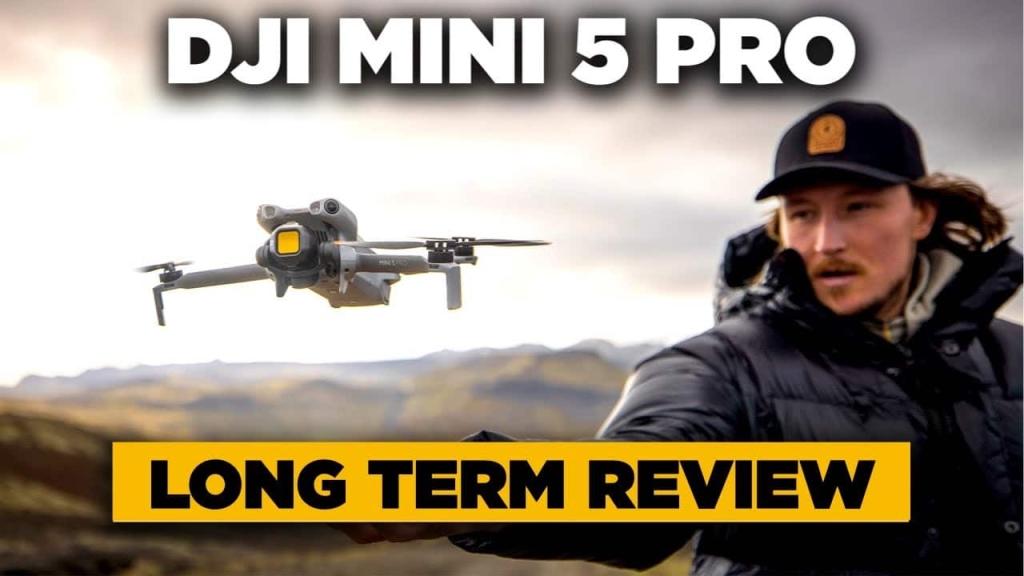 Photo credit: Danny Mcgee
Check out the Best Deals on Amazon for DJI Drones today!
YouTuber Danny McGee has been flying the DJI Mini 5 Pro for months before its official announcement. His verdict: this drone pushes the Mini lineup further than most people expected, and he considers it the number one recommendation for anyone entering the drone space today.
McGee’s video review breaks down the 10 most important things pilots need to know before deciding if the Mini 5 Pro is worth buying. His assessment carries weight because he paid for extended testing time rather than relying on a quick unboxing.
- The Development: The Mini 5 Pro brings significant hardware upgrades including a 1-inch 50-megapixel sensor, forward-facing LiDAR, and 42GB of internal storage to the sub-250g category.
- The “So What?”: Pilots gain professional-level image quality and nighttime safety features previously reserved for larger, more expensive drones.
Internal storage jumps from 2GB to 42GB
The Mini 5 Pro increases internal storage from 2GB on the Mini 4 Pro to 42GB, eliminating the frustration of running out of space mid-flight when an SD card fills up or gets forgotten at home. With the previous 2GB, pilots could capture just a handful of shots before hitting the limit. The expanded storage provides enough capacity to complete an entire shoot without an SD card if necessary.
McGee still recommends using an SD card for easier offloading, but notes this safety net removes the “screwed” feeling pilots experienced when storage ran out on the Mini 4 Pro. This matches what we reported in our DJI Mini 5 Pro beginners guide, where Shawn from Air Photography noted the internal storage as a welcome backup option.
O4 Plus transmission delivers 20km theoretical range
DJI’s O4 Plus video transmission system provides the strongest signal the Mini series has ever had, with theoretical range extending to 20km. McGee acknowledges this distance is largely academic since battery life and legal restrictions prevent most pilots from flying anywhere near that far. The practical benefit shows up in everyday flying: stronger signal stability when obstacles sit between pilot and drone, fewer dropouts in Wi-Fi-heavy environments, and more reliable live feed during complex maneuvers.
Our coverage of the Mini 5 Pro’s FCC filings detailed the revamped antenna system that makes this possible. The drone operates within 2412 MHz to 2462 MHz, supporting IEEE 802.11b/g/n with modulation types including DSSS, CCK, and 64-QAM.
Battery life sees modest improvement from 34 to 36 minutes
McGee expresses disappointment with the battery upgrade. Flight time increases from 34 minutes on the Mini 4 Pro to 36 minutes with the standard battery. He calls this one of the few areas where the Mini 5 Pro falls short of expectations, though he acknowledges DJI packed so many other improvements into the airframe that maintaining any flight time increase deserves credit.
DJI offers a Plus battery option that extends flight time further but pushes total weight over 250 grams, eliminating the regulatory advantages that make the Mini series attractive in the first place. Our long-term battery review found real-world flight times averaging 20-25 minutes depending on conditions, consistent with what filmmaker Philip Bloom reported in his testing.
The 1-inch 50-megapixel sensor transforms image quality
The Mini 5 Pro packs a 1-inch 50-megapixel CMOS sensor into a sub-250g airframe. McGee calls the camera quality “absolutely slaps” and expresses amazement that DJI fit such capable imaging hardware into a drone this small. The sensor supports 4K recording at 120 frames per second, multiple color profiles including D-Log M and HLG, and strong low-light performance that the smaller 1/1.3-inch sensor on the Mini 4 Pro could not match.
For pilots wanting maximum flexibility in post-production, McGee recommends shooting in D-Log M despite requiring color grading. The flatter image profile preserves more dynamic range than the standard color profile, though pilots who prefer not to edit can still achieve good results with the normal profile. Our announcement coverage confirmed DJI designed this sensor to deliver results comparable to the larger Air 3S.
ISO Fusion technology delivers 14 stops of dynamic range
McGee identifies the 14 stops of dynamic range as one of his favorite Mini 5 Pro features. The camera captures detail in both the brightest highlights and darkest shadows simultaneously, solving a persistent frustration for aerial photographers shooting in high-contrast conditions like sunrise and sunset.
The catch: pilots must shoot with auto ISO enabled to access the full 14 stops. DJI’s ISO Fusion technology works by capturing two video streams at different exposures and blending them together. McGee clarifies a common misconception: auto ISO does not mean full auto mode. Pilots can still manually control shutter speed, aperture, and other settings while leaving ISO on auto to benefit from the expanded dynamic range. Our coverage of Philip Bloom’s testing showed the Mini 5 Pro outperforming the Mini 4 Pro in controlled dynamic range comparisons.
Forward LiDAR enables nighttime obstacle avoidance
The Mini 5 Pro adds a forward-facing LiDAR sensor to the existing visual obstacle avoidance cameras. McGee considers this one of the biggest hardware upgrades because it allows the drone to detect obstacles in low-light conditions and full darkness, not just during daytime.
DJI calls this Nightscape Omnidirectional Obstacle Sensing. The LiDAR operates like submarine sonar, using laser pulses rather than relying on cameras that need adequate lighting. For pilots learning to fly, this technology prevents the crashes that inevitably happen when visual sensors cannot detect obstacles in dim conditions. Our testing of the LiDAR system found it functions in conditions under 1 lux, though thin obstacles like power lines remain challenging to detect.
The Fly More Combo bag gets a practical redesign
McGee highlights a detail most reviewers overlook: the Fly More Combo bag grew significantly larger. The Mini 4 Pro bag barely fit the drone, batteries, and controller. The Mini 5 Pro bag adds a large center compartment capable of holding additional gear. McGee notes he rarely flies with just the drone since most shoots involve cameras, snacks, or other equipment. The extra space addresses a real-world workflow problem.
The redesigned gimbal guard also protects the camera and tucks propellers neatly for transport. Our review from Shawn at Air Photography noted similar appreciation for the improved carrying case design.
The 48mm medium telephoto mode adds compositional flexibility
The Mini 5 Pro offers two focal length options: 24mm for the full sensor view and 48mm for a 2x cropped perspective. McGee explains this simulates the telephoto capability found on larger drones like the Air 3S and Mavic 4, where separate lenses provide different fields of view. The 48mm mode pulls subjects closer and compresses foreground against background, creating more dynamic compositions without flying the drone physically closer.
McGee acknowledges this is a digital crop rather than a dedicated telephoto lens. The output remains 4K resolution, but optical purists will notice the difference. He hopes future Mini iterations will include actual secondary lenses, suggesting a 70mm option on a hypothetical Mini 6 would be impressive. Our Mini 5 Pro vs Mini 4 Pro comparison from Mike at Drone Supremacy found the 48mm mode adds welcome flexibility despite producing slightly softer results than a dedicated telephoto lens.
Quick release propellers finally arrive on the Mini series
McGee ranks the quick release propellers among his favorite Mini 5 Pro features. The Mini 4 Pro required a screwdriver to remove propellers, making replacements tedious. The Mini 5 Pro adopts the push-and-twist mechanism DJI has used on larger drones for years: push in, spin, and the propeller pops off.
This upgrade sounds minor until a propeller needs replacement in the field. The old screw-based system created frustration and slowed down workflows. The quick release mechanism brings the Mini series in line with the rest of DJI’s consumer lineup.
The controllable rotating gimbal enables creative shots
McGee identifies the controllable rotating gimbal as the Mini 5 Pro’s most significant creative upgrade. The Mini 4 Pro could switch between landscape and portrait orientation, but the Mini 5 Pro provides full tilt control up to 225 degrees via a dial on the controller. This enables spinning shots and unique perspectives that the Mini 4 Pro could not achieve.
For social media creators shooting vertical content, the native portrait mode captures footage using the full sensor rather than cropping a horizontal image. McGee calls this the best gimbal on any DJI drone in terms of creative flexibility. Our leaked specifications coverage detailed the 225-degree rotation capability before launch.
DroneXL’s Take
McGee’s recommendation aligns with what we have observed across multiple Mini 5 Pro reviews: if you already own a Mini 4 Pro and feel satisfied with it, there is no urgent need to upgrade unless you specifically need the 1-inch sensor or nighttime obstacle avoidance. The Mini 4 Pro remains a capable drone that produces excellent results.
For pilots without a drone or those ready to enter the hobby, the Mini 5 Pro represents the current sweet spot in DJI’s lineup. The combination of professional-level imaging, safety features, and sub-250g weight creates a package that seemed impossible just a few years ago. McGee’s observation that “10 years ago there is no way in my wildest dreams” such specs could fit in something this small captures the industry’s trajectory accurately.
The battery life disappointment McGee expresses reflects a reality we have documented across multiple reviews: DJI’s advertised 36 minutes translates to 20-25 minutes in actual field conditions. Pilots considering the Mini 5 Pro should budget for the Fly More Combo’s three-battery setup to avoid frustration during longer shoots.
US availability remains complicated by the current import situation. Our guide to purchasing DJI drones in the United States details the workarounds available through eBay and authorized resellers, though pilots should understand warranty limitations before purchasing through unofficial channels.
Editorial Note: This article was researched and drafted with the assistance of AI to ensure technical accuracy and archive retrieval. All insights, industry analysis, and perspectives were provided exclusively by Haye Kesteloo and our other DroneXL authors, editors, and YouTube partners to ensure the “Human-First” perspective our readers expect.