
Warren County Community College Launches Counter-Drone Security Training Program
New curriculum will train students and professionals to identify and respond to drone threats
Warren County Community College (WCCC) in New Jersey is expanding its drone education program with a new curriculum focused on counter-drone security. The program will train students and working professionals to identify, assess, and respond to potential threats posed by unmanned aircraft systems.
The new courses will be part of the college’s WarrenUAS program and are expected to begin next fall at the college’s Washington, New Jersey campus. The initiative reflects growing demand for professionals who understand both drone operations and the security challenges created by the technology.
“Drones are an expanding, incredibly valuable tool for nearly every sector of our economy, but it is clear that in the wrong hands they can present a threat to public safety or the security of our infrastructure,” said Warren County Community College President Will Austin. “Our mission at WarrenUAS is to meet the need for professionals who can develop, maintain and pilot drones safely and effectively, but we also want to address the rare but serious threats they can pose.”
Austin said the college began discussing the need for drone security expertise two years ago as the use of drones expanded across many industries.
Experienced Leaders to Develop the Curriculum
The college has enlisted two experienced professionals to develop and lead the program. Brandon Youngblood and L. Scott Parker bring extensive backgrounds in drone operations, policy, and security.
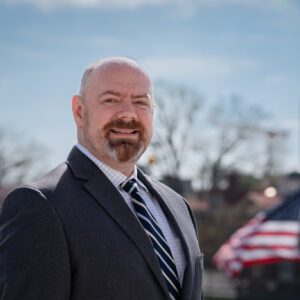
Brandon Youngblood
Youngblood currently serves as vice president for government programs at Spatial Persistent Software Air Domain Awareness. He has more than two decades of experience with unmanned aircraft systems. Over the past seven years, he has focused on national counter-UAS policy, technology, and operations.
Youngblood previously worked at the Federal Aviation Administration. There he managed UAS security oversight, interagency coordination, and security airspace management. As head of the FAA UAS Security and C-UAS Integration Office, he helped develop national security policy and worked with leaders from several cabinet-level agencies. He also served as the senior FAA representative to the policy committee that produced the federal Counter-UAS National Action Plan.

Scott Parker
Parker, founder of Aerisq Solutions, served 27 years in the U.S. Army. He later worked at the Cybersecurity and Infrastructure Security Agency (CISA), where he served as chief of UAS security. In that role, he established the agency’s first dedicated drone security program and helped shape the federal approach to managing drone-related risks.
Parker also launched CISA’s “Be Air Aware” public awareness campaign and helped coordinate flight restrictions over sensitive sites in New Jersey and New York in late 2024. Earlier in his career at CISA, he led national efforts to strengthen protections for cyber-physical systems and critical infrastructure.
Training Students to Understand Drone Threats
The counter-drone program will be open to students who complete WarrenUAS foundational drone training. The new curriculum will focus on identifying threats, understanding regulations, and responding to potential incidents.
“Students entering this program will gain the latest knowledge and training about drones that our WarrenUAS program provides and then explore this critical field of drone security and gain the credential to take positions in the government and private sector where these experts are so critically needed,” Austin said.
Austin added that the expertise of Youngblood and Parker will help ensure the program reflects current industry and policy developments.
“We are very fortunate to have Brandon and Scott building this program to provide the best and most current thinking and technical expertise in the growing, critical C-UAS field.”
Youngblood emphasized that drone security has become a growing concern across multiple sectors.
“A thousand-dollar drone could potentially take out a $200 million f22 fighter jet or poison a water supply or cripple an airport, costing millions,” Youngblood said. “Finding ways to provide protection is now getting a lot of attention and WarrenUAS will be ahead of the curve in broadening our understanding of how to handle those threats and in training professionals to provide that expertise.
Understanding Domestic Drone Risks
The program will also address how to evaluate risks without limiting legitimate drone operations.
“A lot of people see threats in areas of conflict around the world and make that the perspective they take away That certainly is real problem but there are distinct differences between that and the variety of domestic threats out there,” Parker said. “This program will give students an understanding of both and improve industry knowledge in that realm,” Parker said.
“Beyond that, drones are increasingly being used for a wide range of productive, useful purposes, but they may be flying alongside systems used for more nefarious purposes. We need a better understanding of the distinction and trained professionals with a clear conception of both.”
Students in the program will take three courses focused on counter-UAS topics. These courses will cover malicious and illicit drone activity, legal frameworks governing drone use, and the technologies used to detect and respond to threats.
Parker said the courses will examine “what it means to detect, track, monitor, seize or destroy threatening drones”, including the technologies used in modern counter-UAS systems.
He also noted that drone threats present challenges that traditional security frameworks were not designed to address.
“Physical security and aviation policy don’t adequately cover these threats, and in this program, we are addressing that gap. I can tell you from my experience, I’m not aware of anyone else doing this.”
Professional Training and Industry Partnerships
Beyond the academic courses, WCCC plans to offer professional development workshops. These programs will target first responders, law enforcement, and infrastructure security personnel.
Youngblood said the program will draw on industry connections to provide guest speakers and hands-on learning opportunities.
“Drone threats impact just about every type of industry infrastructure, including data centers, prison systems and corporate to national security assets. The potential targets of illicit drone operators are virtually limitless,” Youngblood said. “We’re hoping to develop a curriculum to train students as professionals to address those concerns but also public safety and private security workshops, focusing on drone incursion response and organizational drone security policy development.
Youngblood also pointed to increasing concerns about criminal use of drones.
At a Senate Judiciary Committee hearing last year, Department of Homeland Security Executive Director for C-UAS Steve Willoughby stated that “nearly every day transnational criminal organizations use drones to convey illicit narcotics and contraband across U.S. borders and to conduct hostile surveillance of law enforcement”.
Drones have also been used to deliver contraband into prison systems worldwide. In the 12 months prior to March 2025, officials reported 1,712 drone incidents at correctional facilities.
Expanding WarrenUAS Programs
The new counter-drone training will join several expanding programs at Warren County Community College. These include applications of unmanned systems in agriculture, utilities, transportation, environmental research, and commercial industries.
The WarrenUAS program has grown rapidly over the past seven years. The college expects to enroll more than 100 students next fall. Students train with equipment valued at about $5 million, including multispectral sensors, aerial spraying systems, and AI-based data processing tools.
The college also operates the Smith Flight Training Center, a $500,000 outdoor training facility. The program maintains a fleet of more than 75 unmanned aircraft across more than 30 different platforms.
Chief pilot Peter Miller said workforce training remains a key part of the college’s mission.
“As a community college it is a vital part of our mission to strengthen our county and community. Warren will be adding counter UAS to its current offerings for law enforcement and other essential personnel in and out of Warren County,” he noted.
The college recently received a $15,000 grant from the FirstEnergy Foundation. The funding will support training for smaller police departments and first responders that may not have the resources for advanced drone security education.
Austin said the college will continue expanding its programs to meet growing workforce demand.
“As drone-related security continues to be a growing concern, WarrenUAS is developing curriculum in the counter UAS space utilizing expertise from around the country,” Austin said.