
US Army Unleashes Bumblebee V2 Drone Hunter
 Photo credit: Spc. Adrian Greenwood / Army
Check out the Best Deals on Amazon for DJI Drones today!
The United States Army is about to add a new insect to its battlefield ecosystem, and this one hunts in midair.
In March, the Army’s Global Response Force will begin assessing the Bumblebee V2, a four rotor FPV interceptor designed to chase down and physically ram hostile drones out of the sky, as Defense News report.
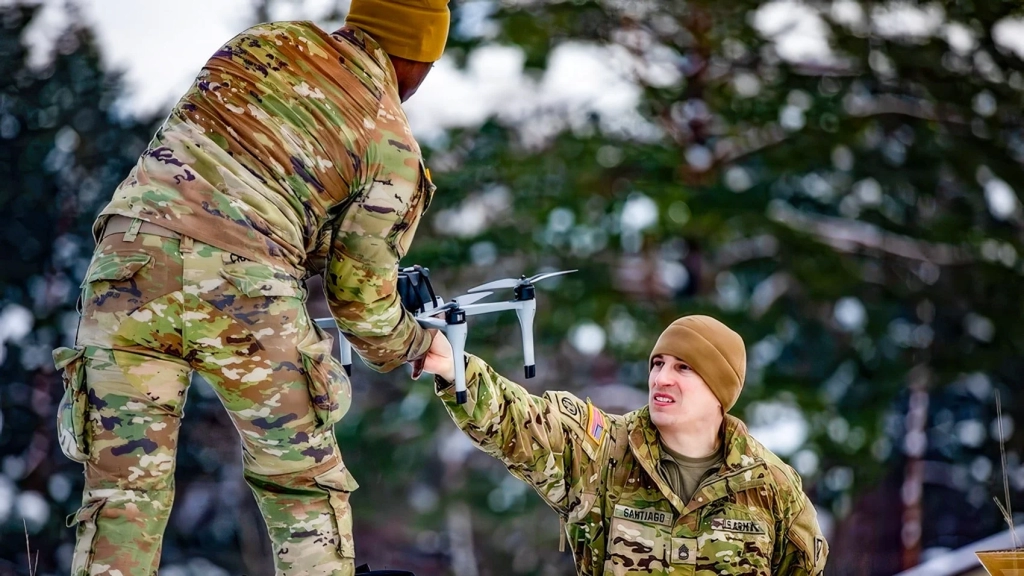 Photo credit: Spc. Adrian Greenwood / Army
The move follows a $5.2 million contract awarded on January 30 by the United States Department of Defense, with deliveries starting next month.
Yes, it is exactly what it sounds like. A drone that tackles other drones.
A Hard Kill Without The Boom
The agreement, announced by the Pentagon’s Joint Interagency Task Force 401, partners the government with defense tech firm Perennial Autonomy to field the Bumblebee V2 as a kinetic counter small UAS solution.
 Photo credit: Spc. Adrian Greenwood / Army
Unlike missile based interceptors or shotgun blasts into the sky, the Bumblebee does not explode. It does not fire a projectile. It simply hunts.
Powered by onboard AI, the FPV quadcopter identifies an incoming unmanned aerial vehicle, lines up its target, and slams into it. The result is a “hard kill” without the blast radius, fragmentation, or urban window shattering side effects that come with traditional munitions.
Brig. Gen. Matthew Ross, director of JIATF 401, said the decision places kinetic counter drone capability directly into soldiers’ hands, calling it essential in a battlespace where small drones are no longer rare surprises but constant overhead guests.
Drone on drone impact might sound primitive, but in dense environments it is surgical compared to bullets or explosives. One flying robot body checks another. Physics does the rest.
Built For The Modern Drone Swarm Era
The Bumblebee V2 also checks an increasingly important box. It complies with updated requirements in the National Defense Authorization Act, which restricts the use of certain foreign components in military systems. That compliance allows for rapid adoption across units without bureaucratic turbulence.
 Photo credit: Spc. Adrian Greenwood / Army
The Army’s Global Response Force will evaluate the system at the Lt. Gen. James M. Gavin Joint Innovation Outpost at Fort Bragg, a newly opened hub designed to connect soldiers, academia, and private industry under one experimental roof.
If successful, the Bumblebee could become a low cost answer to one of the most expensive modern problems. Shooting down a $500 drone with a missile that costs six figures is not sustainable math. Sending another drone to tackle it midair starts to look like battlefield common sense.
 Photo credit: Spc. Adrian Greenwood / Army
DroneXL’s Take
The era of counter drone systems shaped like mini missiles and backed by million dollar price tags is colliding with a harsher reality. Small drones are cheap, disposable, and everywhere. The only scalable answer is something equally agile and equally expendable.
The Bumblebee V2 is not glamorous. It is not a laser cannon. It is not science fiction. It is a flying linebacker with a silicon brain.
And that might be exactly what modern air defense needs.
If this evaluation at Fort Bragg proves successful, expect to see more “drone versus drone” doctrines emerge, especially for urban operations where collateral damage is unacceptable. The sky is turning into a contact sport, and the Army just signed its first middleweight contender.
Photo credit: Spc. Adrian Greenwood / Army