
Shahed-136 Vs. LUCAS: The $35,000 Drone The US Reverse-Engineered From Iran Is Now Being Used Against It
 Photo credit: U.S. Department of Defense
Check out the Best Deals on Amazon for DJI Drones today!
That nasal piston buzz is hard to forget. Anyone who has watched footage from the Gulf over the past week, the kind shot from rooftops in Bahrain and apartment blocks in Dubai, recognizes the Shahed-136’s approach sound before the visual ever registers. It’s slow and loud. It still gets through. That acoustic signature is now showing up in a new context: LUCAS, the US-built loitering munition developed by SpektreWorks, uses a nearly identical airframe derived directly from Iran’s own design, according to reporting cited by Gulf News. Tehran’s innovation is now flying against Tehran.
- The Development: The US military has deployed LUCAS (Low-cost Uncrewed Combat Attack System) in active Gulf operations, a drone reverse-engineered from Iran’s Shahed-136 and priced at approximately $35,000 per unit.
- The “So What?”: Both weapons express the same strategic doctrine — mass, cheap, and expendable — and the side that manufactures faster may control the battlefield outcome.
- The Source: Gulf News published a side-by-side breakdown of both systems on March 6, 2026, drawing on US military imagery from CentCom operating areas.
The Shahed-136’s Combat Record in the Gulf
The Shahed-136, developed by Iran’s Shahed Aviation Industries, is a one-way attack drone with a roughly 3.5-meter fuselage, a 2.5-meter wingspan, and a warhead ranging from 50 kg to around 90 kg depending on the variant. It flies at approximately 185 km/h using GPS and inertial navigation, with a stated range of up to 2,000 km — enough to reach targets well outside Iran’s immediate borders. Unit cost inside Iran runs $20,000 to $50,000; export pricing has been reported as high as $193,000 per unit.
In the opening days of the current conflict, Iran launched hundreds in coordinated waves across the Gulf. Shahed-136s struck targets in Bahrain, Kuwait, and Dubai in a single offensive. The US Embassy in Riyadh was hit by two drones, triggering a fire. A Shahed reached RAF Akrotiri in Cyprus and damaged the runway.
Its strengths are well understood by now: low radar cross-section at altitude, mass simultaneous launch, and a price point cheap enough to make interception economically painful. Its weaknesses are equally well documented. At 185 km/h, it’s slower than most commercial delivery drones in testing. The piston engine is audible from a significant distance. Integrated layered defenses including Patriot and Iron Dome have achieved high interception rates, though the cost asymmetry remains brutal: a PAC-3 Patriot interceptor costs over $13.5 million. The Shahed costs as little as $20,000.
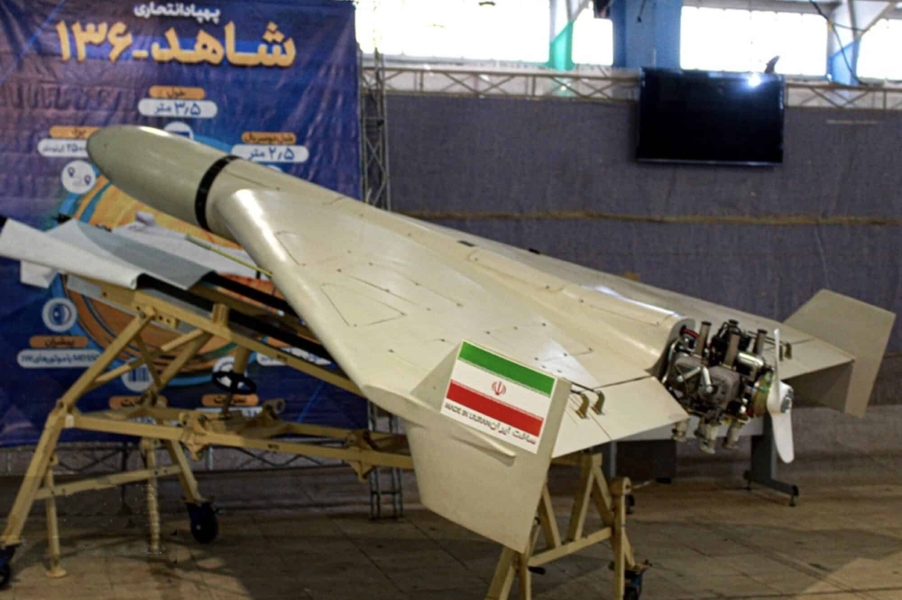 Photo credit: Wikipedia
LUCAS: SpektreWorks’ Answer Built From the Same Blueprint
LUCAS, the Low-cost Uncrewed Combat Attack System developed by Arizona-based SpektreWorks, is classified as a Group 3 UAS and shares the Shahed-136’s triangular delta-wing geometry — the same design choice that reduces structural parts and simplifies assembly. At $35,000 per unit, it sits within the low end of the Shahed’s domestic cost range. The US military introduced it publicly in July 2025; DroneXL covered Secretary of Defense Pete Hegseth’s Pentagon showcase at that time.
What separates LUCAS from its Iranian counterpart is the guidance system and networking architecture. Where the Shahed-136 relies on GPS and inertial navigation, LUCAS is designed for autonomous coordination. Its FLM 131 attritable frame is built so drones can communicate and adapt with each other mid-flight — a capability the Shahed-136 does not have. LUCAS has already been launched from naval vessels in the Gulf during the current conflict, with reported battlefield roles including targeting missile launch sites and radar infrastructure.
LUCAS also functions as a communications relay within the Multi-domain Unmanned Systems Communications (MUSIC) mesh network, maintaining data links between US and partner units even under electronic jamming.
Side-by-Side: Shahed-136 vs. LUCAS
| Category | Shahed-136 (Iran) | LUCAS (United States) |
|---|---|---|
| Developer | Shahed Aviation Industries | SpektreWorks + US military |
| Length | ~3.5 m | Similar triangular design |
| Wingspan | ~2.5 m | ~2.5–3 m class |
| Speed | ~185 km/h | Similar class |
| Range | Up to ~2,000 km | Comparable range category |
| Payload | ~50–90 kg warhead | Comparable explosive payload |
| Guidance | GPS / inertial navigation | Designed for autonomous coordination and networking |
| Launch | Rack launch / rocket assist | Catapult, mobile launcher, or ship launch |
| Unit Cost | $20k–$50k domestic; ~$193k export | ~$35,000 |
| Role | Mass saturation attacks | Swarm strike and counter-swarm operations |
Production Scale Is the Actual Weapon
The triangular delta-wing design that both drones share isn’t aesthetic — it’s an engineering decision that reduces structural components, cuts assembly time, and makes mass production feasible at facilities that don’t require aerospace-grade tooling. Russia reportedly plans to build tens of thousands of its Shahed clone annually. That production logic is now the US military’s explicit doctrine: the Pentagon’s shift toward “attritable warfare” is the idea that weapons should be cheap enough to lose in volume without a budget crisis.
Gulf states have been firing PAC-3 Patriot missiles at $13.5 million per shot to intercept drones costing as little as $20,000 — a ratio that cannot hold. The answer isn’t a more expensive interceptor. It’s a cheaper one. Ukraine figured this out earlier than most, which is why Zelenskyy confirmed the US has formally asked Ukraine for anti-Shahed expertise — a striking reversal of the typical technology transfer direction. The $2,500 interceptor drone solution Ukraine has been deploying is one the Gulf is still largely ignoring.
Meanwhile, the US Army has stated ambitions for 340,000 drones — but the gap between declared intent and actual fielded units remains significant. LUCAS is one concrete step toward closing it.
DroneXL’s Take
Head-to-head comparisons miss the point here. Both the Shahed-136 and LUCAS are expressions of the same military conclusion: precision matters less than volume when defenses are finite and economics are asymmetric.
What I find genuinely striking about LUCAS is the honesty of the reverse-engineering. The Pentagon didn’t try to build something more sophisticated than the Shahed. It built something functionally equivalent and added a networking layer on top. That’s a pragmatic call. The Shahed-136’s airframe already proved the concept at scale across Ukraine, and now across the Gulf. Why redesign what works?
The networking capability is the real differentiator. A Shahed swarm saturates defenses through volume and timing — essentially a dumb saturation attack that relies on numbers. LUCAS is designed so a swarm can coordinate in flight, adapting to which targets are defended and where the sensor gaps are. That’s a qualitative jump that won’t show up in a spec table. Whether that capability has been exercised in combat remains unconfirmed. The architecture exists by design; the battlefield proof doesn’t yet.
My prediction: by September 2026, we’ll see the first publicly documented case of a LUCAS swarm autonomously redistributing targeting priorities mid-mission in response to active air defense. When that gets confirmed, the doctrine debate about meaningful human control in lethal autonomous systems will shift from academic to urgent, fast.
The side that manufactures more will shape the battlefield. Right now, Iran has the production head start. LUCAS is the US catching up — but production capacity, not engineering elegance, is what decides this.
Editorial Note: AI tools were used to assist with research and archive retrieval for this article. All reporting, analysis, and editorial perspectives are by Haye Kesteloo.