
Ottonomy Launches Ottumn.AI Orchestrate Drones And Robots
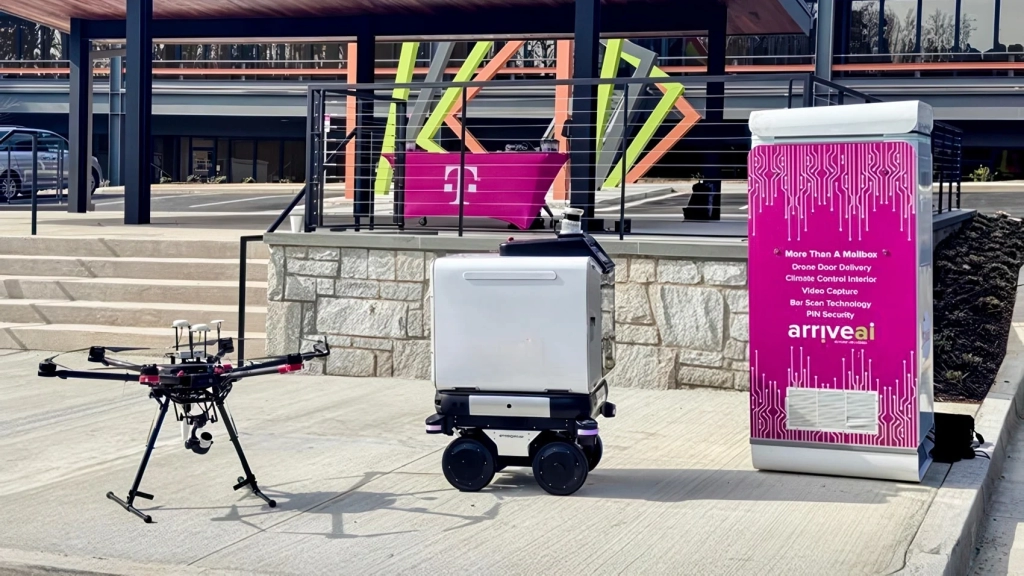 Photo credit: Ottonomy
Check out the Best Deals on Amazon for DJI Drones today!
At the India AI Summit, California based Ottonomy.IO unveiled Ottumn.AI, a cloud orchestration platform designed to coordinate robots, drones, and smart infrastructure as if they were sections of the same mechanical orchestra, as published by The Robot Reports.
The company built Ottumn.AI on NVIDIA artificial intelligence infrastructure, with backing from the NVIDIA Inception program. The goal is ambitious. Move from isolated machines performing single tasks to fully orchestrated autonomy across healthcare, manufacturing, and local e-commerce.
Instead of a cleaning robot doing its rounds in one corner, a drone flying separately across town, and a smart mailbox waiting passively for parcels, Ottumn.AI attempts to connect them into one synchronized ecosystem.
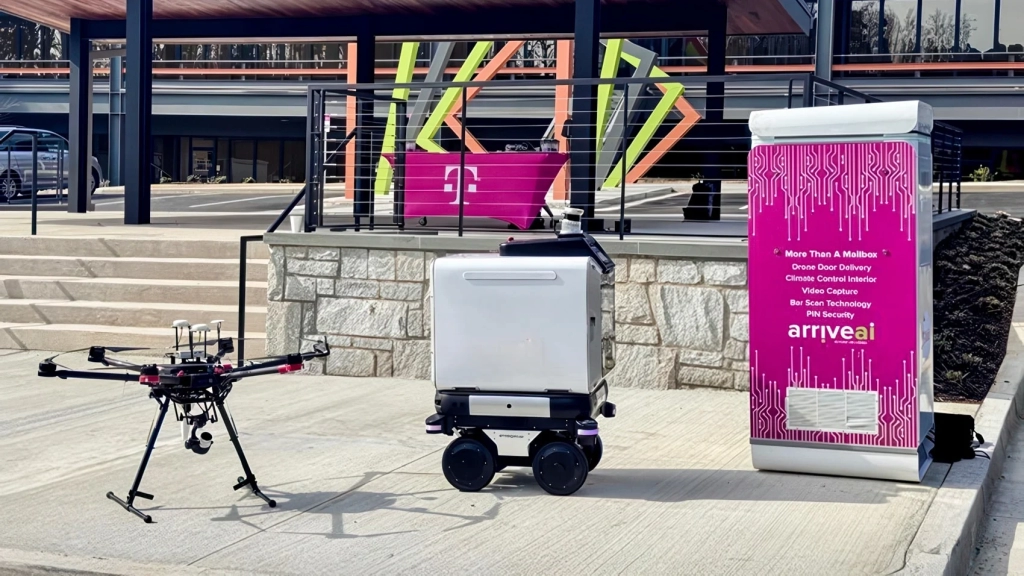 Photo credit: Ottonomy
According to founder and CEO Ritukar Vijay, the platform represents what he calls an asynchronous deliveries framework. In practical terms, that means robots, drones, elevators, access doors, and smart receptacles working together in live environments such as hospitals, campuses, and urban sidewalks without requiring humans to stand at every handoff point.
Neurosymbolic AI Meets Physical Infrastructure
At the core of Ottumn.AI is a neurosymbolic architecture. That phrase sounds academic, but the idea is straightforward. Combine neural networks for perception with symbolic logic for rule based reasoning.
In simple terms, robots see with AI and think with logic.
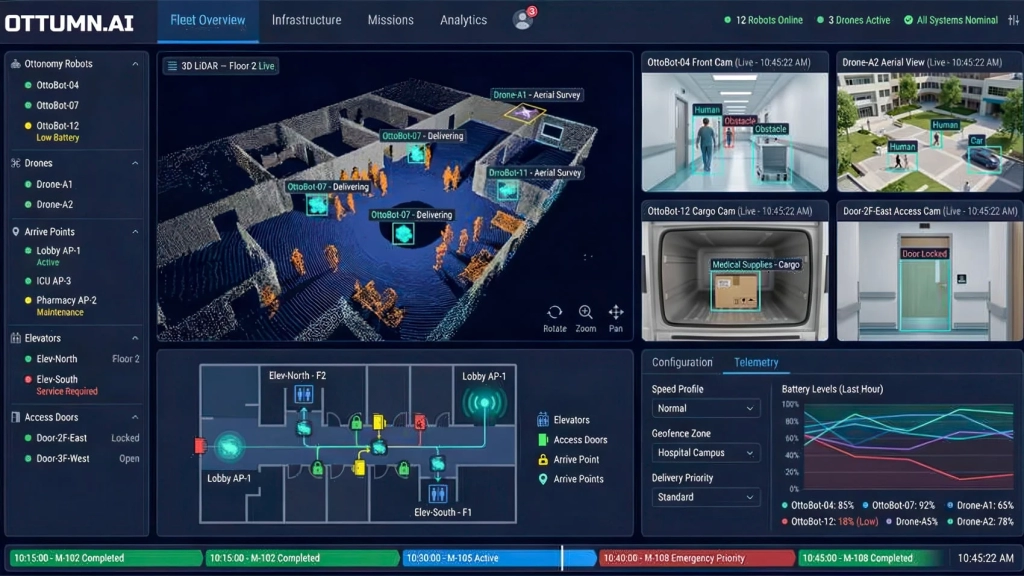 Photo credit: Ottonomy
The system uses vision language models to interpret surroundings while relying on symbolic reasoning to follow operational and safety constraints. In a hospital, that might mean recognizing a hallway obstruction while strictly respecting restricted access zones and hygiene protocols.
The architecture spans multiple layers:
Edge intelligence powered by NVIDIA Jetson modules enables sub 30 millisecond decisions on device. Cloud GPUs handle simulation, digital twins, and vehicle to everything coordination. The platform leverages NVIDIA Isaac Sim to create virtual replicas of environments for testing before deployment.
For on device computing, it relies on NVIDIA Jetson, while NVIDIA accelerated computing manages fleets at scale.
Ottonomy also plans to incorporate NVIDIA Cosmos and NVIDIA Nemotron models for future development. The strategy is clear. Build a foundation that can expand as AI models become more capable.
Interoperability is another key element. Ottumn.AI complies with the VDA 5050 standard, which enables vendor agnostic automated guided vehicle fleets to communicate and coordinate. In a world where factories and hospitals often mix equipment from multiple suppliers, that flexibility reduces vendor lock in and simplifies scaling.
Asynchronous Delivery and Smart Handoffs
The real test of any orchestration platform is not theory. It is the handoff.
Ottonomy is working with Arrive AI to integrate Arrive Points, secure and climate controlled receptacles that act as universal exchange nodes. A ground robot can deposit medicine into a temperature regulated box with UV sterilization, and hospital staff can retrieve it later without direct interaction.
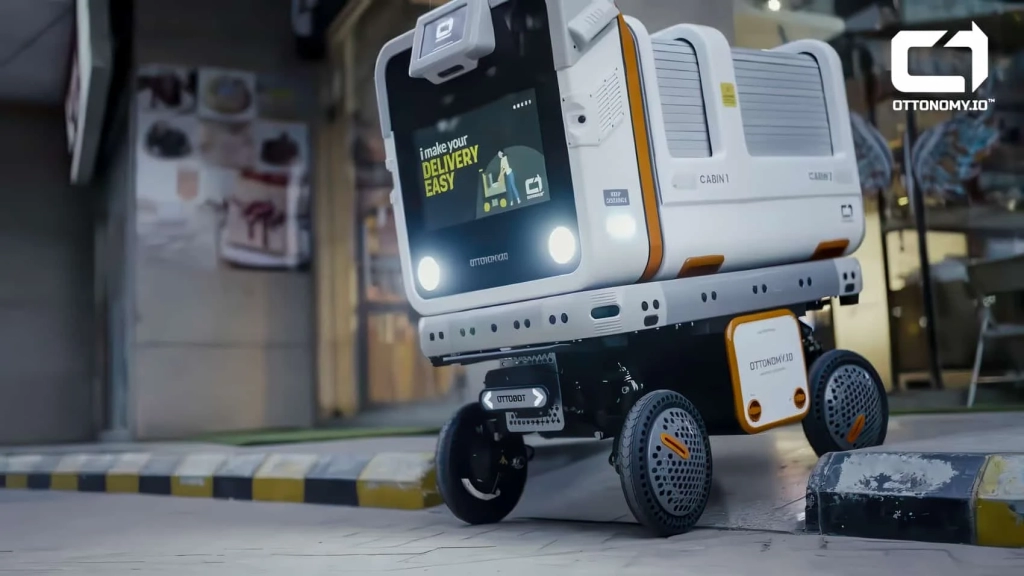 Photo credit: Ottonomy
In healthcare settings, that translates into fewer interruptions for nurses and faster specimen transfers between departments.
For aerial logistics, Ottonomy has partnered with Skye Air Mobility, a drone delivery network in India. Ottumn.AI coordinates handoffs between ground robots and drones, enabling goods to move across congested urban areas through a mix of rolling and flying assets.
The company describes this as true last inch delivery. Not just getting a parcel to a building, but integrating with elevators, access doors, and smart boxes to complete the chain autonomously.
The carbon argument also enters the picture. Coordinated drones and electric ground robots could reduce emissions compared to traditional courier vans, particularly in dense city environments.
From Isolated Machines to Coordinated Fleets
Manufacturers and logistics operators are under pressure from labor shortages and rising efficiency demands. Ottonomy positions Ottumn.AI as a solution to the last mile gap by connecting previously siloed machines into a unified network.
Instead of separate dashboards for each robot type, the platform offers cloud teleoperation, fleet coordination, and performance optimization from a centralized interface. Remote assistance remains available, adding a human safety net without placing staff at every transfer point.
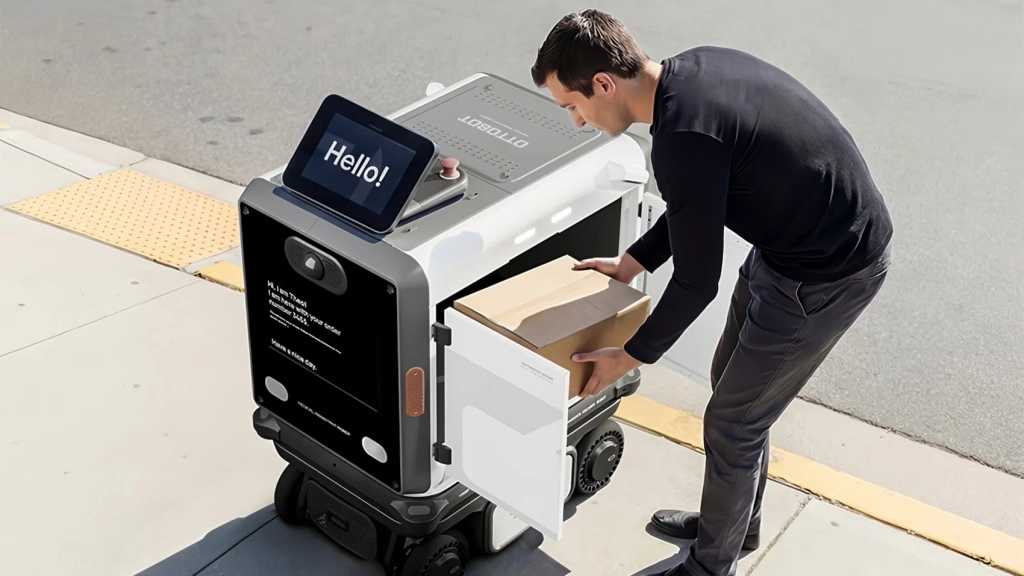 Photo credit: Ottonomy
The company plans to demonstrate Ottumn.AI at the India AI Impact Summit 2026 in a multi modal mission involving robots, drones, and building systems working in concert.
If successful, the demonstration will show more than a delivery. It will show choreography.
DroneXL’s Take
For the drone industry, the most interesting aspect of Ottumn.AI is not the robots. It is the orchestration layer.
Drone hardware has matured rapidly. What remains complex is integration. Handoffs between air and ground assets, compliance with building systems, and coordination with smart infrastructure are where friction still lives.
By anchoring its platform in NVIDIA’s AI stack and embracing interoperability standards like VDA 5050, Ottonomy is betting that the future of drone delivery is not a single aircraft flying point to point. It is a network of machines that share context.
The risk, of course, lies in execution. Orchestration sounds elegant in a keynote. Real world environments are messy, crowded, and regulated.
But if Ottumn.AI can truly connect drones, robots, elevators, and smart receptacles into one reliable system, it moves the industry closer to something bigger than delivery. It moves toward infrastructure level autonomy, where the sky, the sidewalk, and the building lobby are all part of the same digital nervous system.
Photo credit: Ottonomy