
From Munich Security Conference to Capability Priorities — Why Drones and C-UAS Are Now Core to Europe’s Defense Doctrine
As Europe’s premier strategic security forum, the 62nd Munich Security Conference (MSC 2026) offered more than its usual round of geopolitical speeches and headline-grabbing bilateral meetings. This year, amid heightened threats and deepening questions about transatlantic guarantees, a quieter but no less significant shift was visible in the language used by European policymakers and strategic analysts: unmanned systems, both drones and counter-UAS, are no longer marginal capabilities but essential elements of Europe’s defense doctrine.
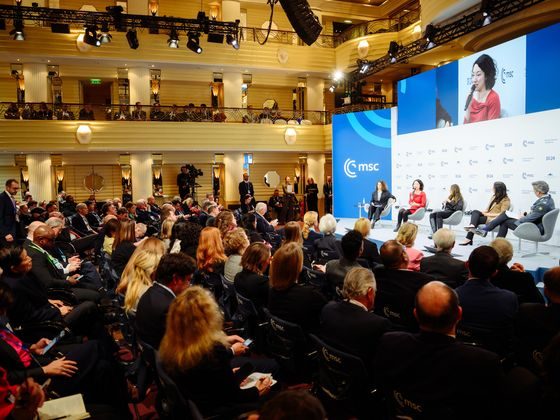
A Strategic Inflection Point
Held from February 13–15 in Munich, Germany, MSC 2026 took place against what the official Munich Security Report 2026, titled Under Destruction, describes as a “moment of profound uncertainty” for European security. Russia’s ongoing war in Ukraine, hybrid pressure across the continent, and skepticism over the durability of longstanding alliances all contributed to a notion that the security environment has fundamentally shifted.
Across this backdrop, Europe’s defense planning is being recalibrated from reactive crisis management to sustained readiness. One clear signal of that evolution appears in how drones have been framed not as niche technologies but as capability priorities on par with traditional defense functions such as air and missile defense.
Drones as a “Shared Capability Priority”
New language from the Munich Security Report 2026 itself underscores how unmanned systems have moved from peripheral concerns into the center of European defense planning. The report calls for “rapid agreement on shared capability priorities” and highlights significant gaps in critical areas, including air defense, intelligence, and other key systems that modern conflict increasingly depends on. It states that to confront emerging threats, Europe must build “sustained increases in defense spending” and align on “critical capability priorities,” implicitly encompassing unmanned platforms and the ecosystems that support them.
The report explicitly documents how hybrid activity, including a “sharp escalation in suspected Russian … unauthorized drone overflights” across several NATO and EU states, has tested Europe’s current defenses and exposed operational vulnerabilities. In doing so, it reinforces that persistent ISR, airspace monitoring, and rapid response mechanisms are now indispensable components of the continent’s collective security architecture, not optional add-ons.
Lessons from Ukraine and the Security Imperative
European Commission President Ursula von der Leyen, in speech excerpts from the Conference, underscored the broader security context shaping policy priorities for the bloc. According to press coverage of her remarks, she stressed that Europe must “learn security lessons from Ukraine” and be prepared to act decisively ahead of emerging threats.
Von der Leyen also amplified the call for a more robust collective defense posture, urging EU member states to activate and “bring to life” the bloc’s mutual defense clause, framing it as a binding security obligation rather than a symbolic commitment.
While her comments did not mention drones by name, the strategic logic she outlined – collective readiness, shared capability development, and reduced reliance on external guarantees – maps directly onto the Munich Security Report‘s elevation of unmanned systems in capability planning.
A Doctrine Adapted to Hybrid Threats
What distinguishes Europe’s current security discourse and differentiates it from past iterations is how threats are perceived. Beyond classical military engagements, Europe now confronts hybrid and gray-zone activity, where non-traditional vectors like drone overflights, cyberattacks, and airspace violations blend into persistent strategic pressures.
Past incidents such as drone incursions into German airspace and violations of allied territory underscore the need for comprehensive detection and response capabilities.
This perspective naturally elevates both UAS and C-UAS technology from tactical tools to strategic enablers: platforms that provide situational awareness at speed, serve as force multipliers under constrained conditions, and offer defense planners flexible, distributed capability at a relatively accessible cost.
Industrial and Procurement Realities
An important theme in the MSC report is Europe’s defense industrial fragmentation and its implications for capability autonomy. The report highlights how national procurement practices have often relied heavily on third-country suppliers, particularly from outside Europe, limiting joint operational and industrial coherence.
For unmanned systems developers and suppliers, this signals both a challenge and an opportunity:
-
As European governments emphasize standardized, interoperable UAS/C-UAS procurement, demand could grow for open architectures, modular systems, and scalable production approaches;
-
At the same time, national siloes could slow aggregated capability build-up unless collaborative procurement mechanisms such as joint EU or NATO purchasing initiatives are adopted more broadly.
The notion of “buying together” rather than “buying alone” appeared in multiple high-level discussions at Munich, reflecting a shared recognition that Europe’s security industrial base must evolve if it is to deliver on the strategic aims articulated in the MSC report and by policymakers like von der Leyen.
What This Means for European Defense Doctrine
Taken together, the directional cues from MSC 2026 and European leadership suggest an emergent doctrine where:
-
Drones and counter-drone systems are core components of defense planning, not add-ons;
-
Persistent airspace situational awareness and rapid attribution are prioritized over perimeter security alone;
-
Interoperable, scalable procurement frameworks are increasingly necessary to field UAS/C-UAS capabilities at speed and scale; and
-
Shared readiness and defense sovereignty are no longer abstract concepts but concrete policy goals driving capability investment.
This doctrinal evolution reflects a broader realignment of European strategic priorities — one shaped not by transient headlines, but by hard insights into the realities of modern warfare and security ecosystems. In that sense, drones are not simply technologies on a checklist. They are building blocks of a renewed defense architecture capable of responding to hybrid pressures, conventional threats, and the uncertainties of a fragmented strategic environment.