
 Photo credit: Ratel Robotics
Check out the Best Deals on Amazon for DJI Drones today!
Ukraine has just fused two battlefield trends into one system. Ground robots and jam resistant FPV drones are now working as a single unit, as United24 reports.
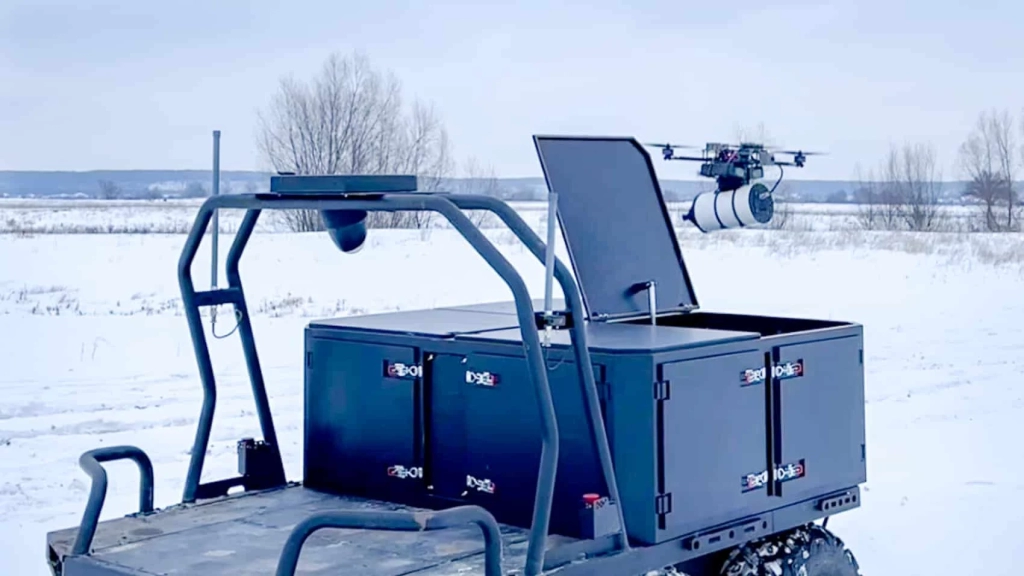
The Ukrainian company Ratel Robotics announced on February 18 that its domestically produced Ratel H unmanned ground vehicle has been upgraded with a new launch module capable of carrying and deploying fiber optic controlled FPV drones.
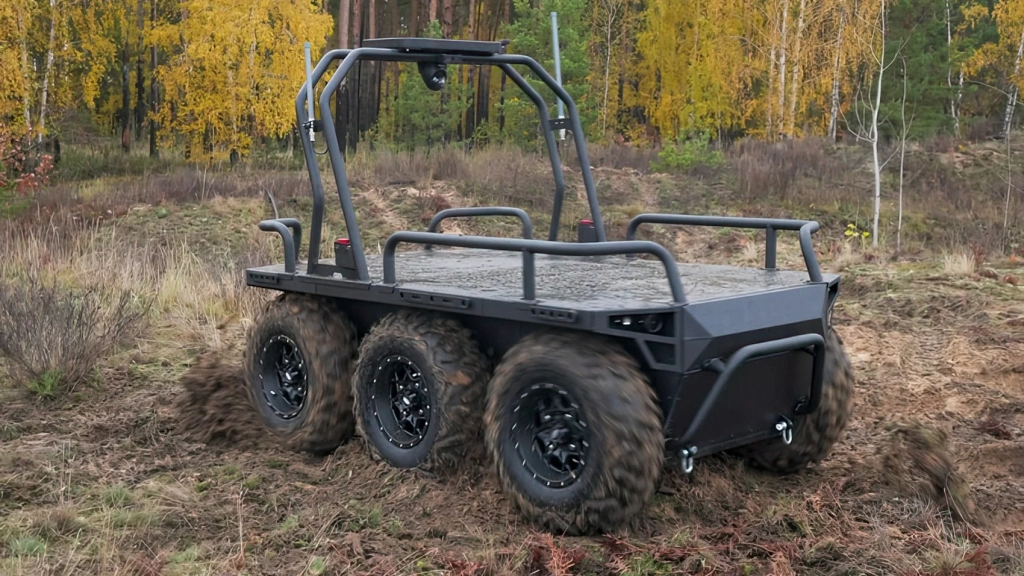 The original Ratel H
Photo credit: Ratel Robotics
The result is a mobile drone platform that can move into high risk areas and launch attacks without exposing operators.
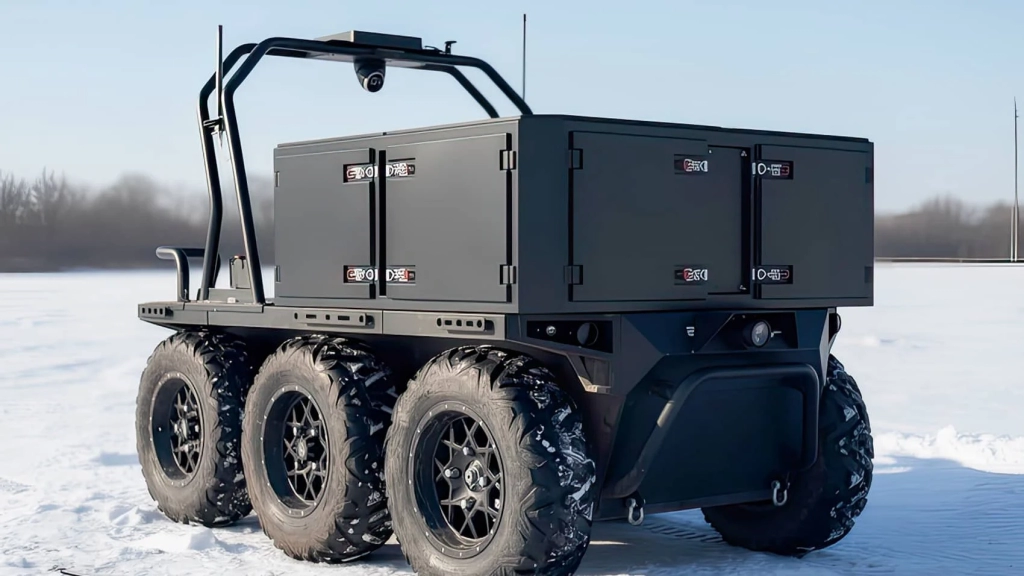 The new Ratel Drone Launcher
Photo credit: Ratel Robotics
In a war where electronic warfare often decides outcomes before the first explosion, this is not a minor tweak. It is a practical answer to a very real problem.
A Mobile Launch Point Built For Contested Airspace
According to Ratel Robotics, the new module integrates directly into the base configuration of the Ratel H without reducing its mobility or cross country performance. The platform can reportedly carry up to four fiber optic FPV drones of different sizes.
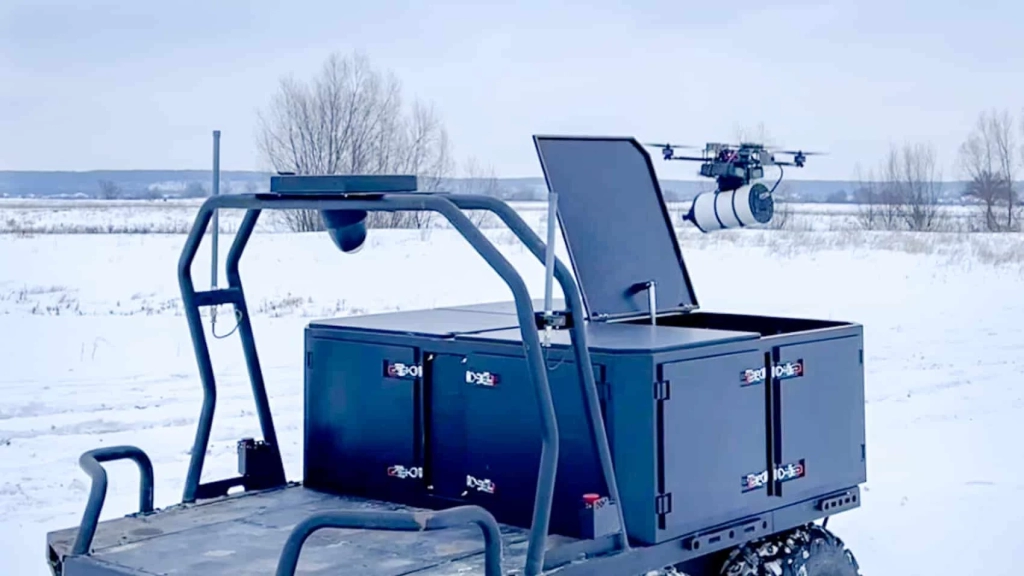 Photo credit: Ratel Robotics
The concept is simple but effective. Instead of launching drones from fixed positions or from trenches near the front, operators can send the Ratel H forward as an unmanned launch pad. Once in position, it deploys the drones while the human crew remains at a safer distance.
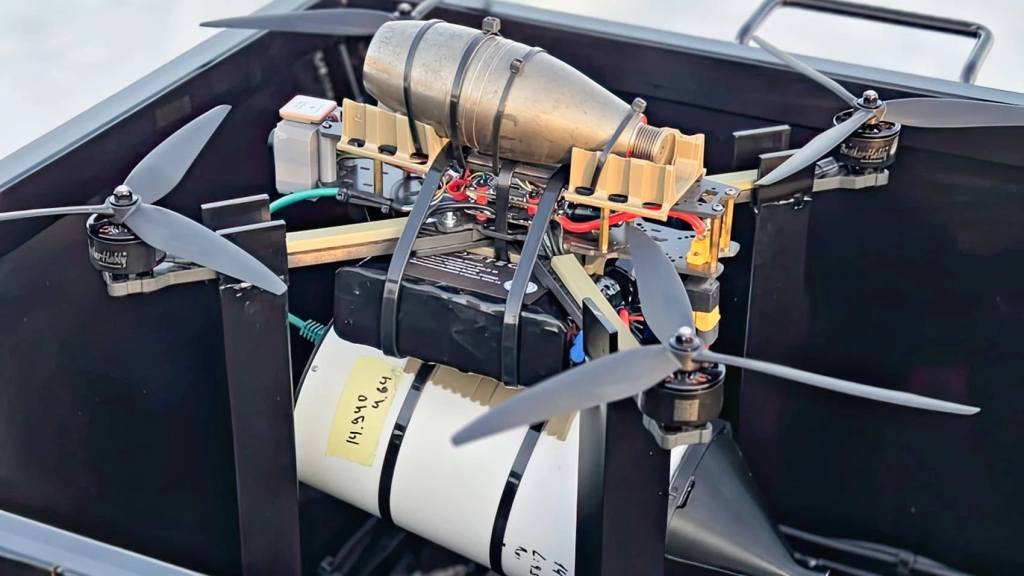 Photo credit: Ratel Robotics
Fiber optic control is the defining feature here. Unlike traditional radio controlled FPV drones, which rely on wireless links that can be jammed or disrupted, fiber optic drones are physically tethered by a thin cable that unspools during flight. This direct connection makes them far less vulnerable to electronic warfare systems that flood the spectrum with interference.
Electronic jamming has become one of the dominant forces on the Ukrainian battlefield. GPS signals are spoofed. Radio links are cut. Standard FPV drones can lose control mid mission. Fiber optic systems sidestep that vulnerability.
In practical terms, this means more reliable strikes in heavily contested environments. The drone stays connected. The operator keeps control.
By combining that resilience with a mobile ground robot, Ukraine is adding another layer to its unmanned ecosystem.
From Logistics Mule To Strike Enabler
The Ratel H was originally designed as a multi purpose unmanned ground vehicle. According to the company, it can evacuate casualties, deliver medical supplies and ammunition, and transport cargo weighing up to 400 kilograms. It reportedly has an operational range of up to 60 kilometers and a deployment radius of around 50 kilometers.
It is also equipped with infrared headlights and night vision cameras, enabling operations in low visibility conditions.
With the addition of the drone launch module, the Ratel H moves beyond logistics support and into direct combat enablement. It can now function as a forward drone deployment point in combined ground and aerial operations.
This kind of integration reflects a broader shift in Ukrainian tactics. On February 17, Ukrainian Defense Minister Mykhailo Fedorov said that Ukrainian forces conducted more than 7,000 combat and logistics missions using ground robotic systems in January alone.
That figure suggests that unmanned ground vehicles are no longer experimental tools. They are becoming routine assets on the frontline.
The Ratel H upgrade fits squarely into that trend. Rather than fielding isolated technologies, Ukraine is increasingly combining systems into layered solutions. A ground robot becomes a drone carrier. A logistics platform becomes a strike enabler.
This is battlefield adaptation at speed.
DroneXL’s Take
What we are seeing here is convergence.
Ukraine is not just building drones. It is building systems of systems. The Ratel H with a fiber optic drone launcher is a clear example of how quickly modern warfare is evolving when innovation cycles are measured in weeks, not years.
Fiber optic FPV drones have already proven their value in contested airspace where jamming is constant. Mounting them on a mobile, unmanned ground platform reduces operator risk while extending reach. That combination increases survivability and flexibility at the same time.
For drone professionals watching this conflict, the lesson is clear. Electronic resilience is no longer optional. And modular design, where a platform can be reconfigured for new roles, is becoming a decisive advantage.
The battlefield is turning into a network of connected machines. Ukraine is showing that adaptability may be just as important as firepower.
Photo credit: Ratel Robotics