
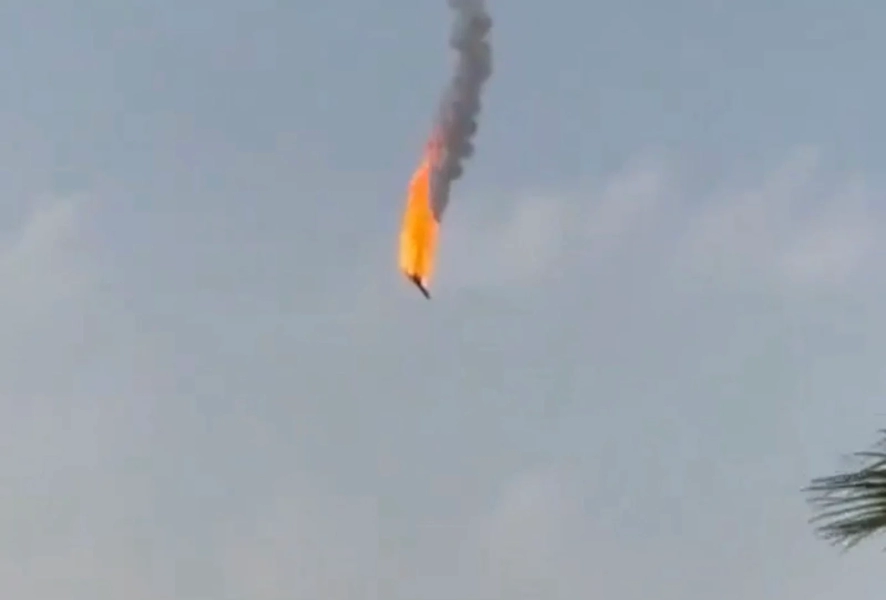
 The photo reportedly shows a Shahed 136 drone that was shot down over Kuwait. Photo credit: X
Check out the Best Deals on Amazon for DJI Drones today!
The buzzing sound is unmistakable. Anyone who has watched footage of a Shahed-136 inbound over a city knows it — that flat, nasal drone of a small piston engine, audible seconds before impact. That sound hit Manama, Kuwait City, and Dubai this weekend. If you’ve been following the Shahed’s trajectory from Ukrainian skies to the Arab Gulf, none of this is a surprise. The surprise is how many buildings it took to make the world pay attention.
- The Development: Iran fired waves of Shahed-136 one-way attack drones at Bahrain, Kuwait, and the UAE on Saturday, March 1, following U.S. and Israeli strikes that killed Ayatollah Ali Khamenei.
- The Targets: Verified footage shows Shaheds hitting a high-rise residential building in Manama, a U.S. Navy base in Bahrain, and the Fairmont Palm luxury hotel in Dubai’s Jumeirah neighborhood.
- The Math: At an estimated $20,000–$50,000 per drone depending on production source, with a range of up to 2,000 kilometers, the Shahed-136 gives Iran the ability to reach every U.S. military installation in the Gulf at a cost that air defense systems can’t sustainably absorb.
- The Source: Reporting by Sanjana Varghese and Adam Rasgon for The New York Times, published March 1, 2026.
The Shahed-136’s Gulf Debut: What Hit and Where
The Shahed-136 is a one-way attack drone — a kamikaze system that flies to a GPS-locked coordinate and detonates on impact. Designed and manufactured by HESA (Shahed Aviation Industries), an Iranian state-owned defense manufacturer, it has been in production since at least 2021, used previously in Iraq, and fired by Russia against Ukrainian cities in the tens of thousands. This weekend it came to the Gulf in force.
New York Times-verified footage from Saturday shows three distinct strike locations. In Manama, a Shahed hit a high-rise residential building — the buzzing audible on camera before the triangular airframe punched into the structure and started a fire. A second video shows a Shahed appearing to strike infrastructure inside a U.S. Navy base in Bahrain, with dark smoke already rising from the compound when the drone came into frame and curved into its impact. A third clip, filmed in Dubai’s Jumeirah district, shows a Shahed striking the Fairmont Palm hotel.
Iran’s senior official Ali Larijani said on social media that Iran was not targeting Arab countries but U.S. bases hosted on Arab soil. The residential building in Manama makes that framing hard to hold.
Why a Low-Cost Drone Keeps Winning
The Shahed-136 costs roughly $20,000 per unit in Iranian domestic production — the Russian-manufactured Geran-2 variant runs closer to $35,000–$50,000. Either way, it carries a payload of explosives, reaches targets up to 2,000 kilometers away without a runway, and can be produced in volumes that strain air defense economics. It is not a precision weapon by missile standards, but it doesn’t need to be. Hitting a building, a port facility, or a fuel depot is well within its capability.
Seth Frantzman, author of Drone Wars: Pioneers, Killing Machines, Artificial Intelligence, and the Battle for the Future (2021), told the Times that Shaheds are “ineffective compared to other weapons” in isolation but can occasionally slip past expensive air defense systems. “They give the Iranians a cheap air force-like weapons system,” Frantzman said. The key phrase there is “cheap air force.” Interceptors cost far more than the drones they’re shooting down. Do that math at scale and the defender loses economically even when they win tactically.
We covered this economic logic in depth when the Pentagon first wrestled publicly with cheap drone economics in the Red Sea. That problem just got a lot more concrete.
The Shahed’s Journey: Ukraine to the Gulf
The Shahed-136‘s combat record predates this weekend’s strikes by years. Russia began using Iranian-supplied Shaheds against Ukrainian civilian infrastructure in 2022, designating them Geran-2 for domestic branding. The program evolved fast. As we detailed in February, Iran gave Russia not just finished drones but full production blueprints, enabling Russia’s Tatarstan factory to now produce hundreds of Geran-type drones per day. Russia has since built at least five distinct variants, including jet-powered versions capable of 230 mph.
Ukraine has absorbed more than 57,000 Shahed-type strikes since the full-scale invasion began in February 2022, which is why President Zelensky called Ukraine’s intercept expertise “largely irreplaceable” on March 1 and offered to deploy Ukrainian specialists to help Gulf states now absorbing the same weapon. Ukraine’s destruction of Shahed relay stations in Belarus last week shows how sophisticated the counter-Shahed fight has become. Gulf air defense teams are starting from scratch by comparison.
LUCAS: The U.S. Fires Iran’s Own Design Back
The same weekend Iran’s Shaheds hit Dubai, the U.S. confirmed it had deployed its own reverse-engineered version of the same airframe. LUCAS (Low-Cost Unmanned Combat Attack System), built by Arizona-based SpektreWorks, saw its combat debut in Operation Epic Fury, the U.S.-Israel strike campaign that killed Khamenei. CENTCOM issued a public statement confirming the deployment, though independent verification was not possible at time of writing.
SpektreWorks built LUCAS by capturing a damaged Shahed airframe and rebuilding it around American electronics, adding autonomous AI flight controls, GPS-denied inertial navigation, and swarm coordination. The price point is similar: roughly $35,000 per unit. The drone that Iran pointed at U.S. bases in Bahrain this weekend shares its origins with the weapon the U.S. fired at Iranian military sites on Friday — though LUCAS carries substantially more capable navigation and coordination systems than the original.
There is also a China dimension worth watching. A separate report from Middle East Eye this week claims China sent attack drones to Iran, including loitering munitions. No confirmed model names or physical evidence have emerged. But if Chinese systems join the Shahed mix in future strikes, Gulf air defenders will need new playbooks.
DroneXL’s Take
I’ve covered Shahed strikes against Ukrainian cities for three years. The footage from Manama this weekend looked identical to footage from Kyiv, Odessa, or Zaporizhzhia — the same triangular silhouette, the same engine whine, the same fireball on impact. The drone didn’t change. The geography did.
What’s changed most is the audience. When Shaheds were hitting Ukrainian apartment buildings, much of the world treated it as a regional problem with a distant war. Now one hit a luxury Dubai hotel during tourist season, another appears to have struck a U.S. Navy base, and a French military base in Abu Dhabi also took a drone hit. That’s a different political category entirely.
The LUCAS deployment matters here too. The U.S. fired a Shahed-derived system at Iran the day before Iran fired Shaheds at U.S. bases. Both sides are operating from the same basic playbook: cheap, mass-producible, hard to intercept at volume. Iran figured it out first. The U.S. caught up. Now the Gulf is the test range.
The demand signal from Gulf states for serious air defense will be real and immediate. Patriot batteries can’t economically fight $20,000–$50,000 drones. The market for cheap drone interceptors — electronic warfare, laser systems, and low-cost kinetic interceptors — just got validated in the most public way possible. My prediction: by September 2026, at least three Gulf states will have signed procurement agreements specifically for counter-Shahed systems, with Ukraine and the U.S. both competing for those contracts.
Editorial Note: AI tools were used to assist with research and archive retrieval for this article. All reporting, analysis, and editorial perspectives are by Haye Kesteloo.