
Germany Buys American Drones For Submarine Hunting While Brussels Debates European Alternatives
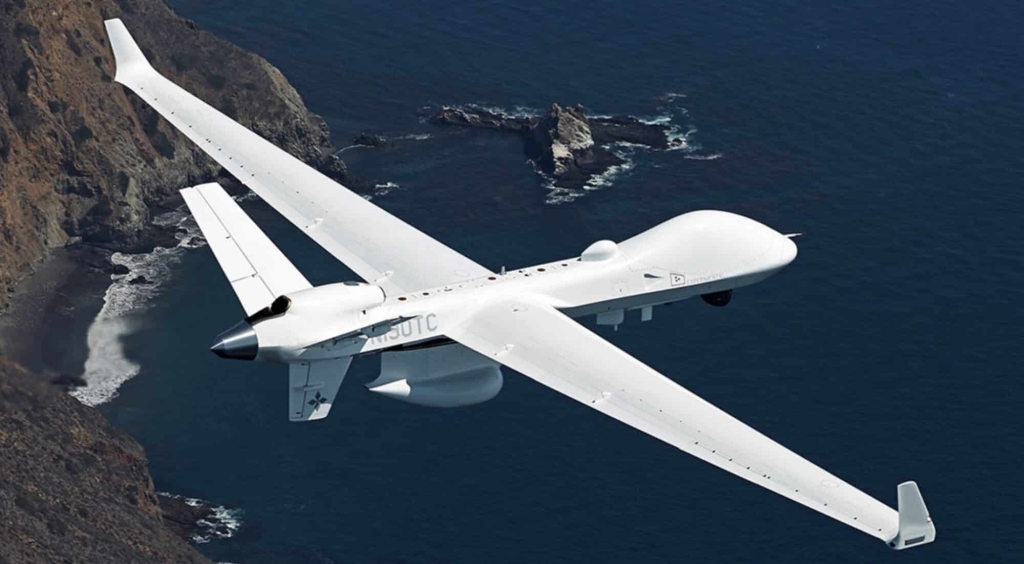 The MQ-9B SkyGuardian fixed-wing drone airborne over the ocean. Photo credit: General Atomics Aeronautical Systems
Amazon Drone Deals: DJI Mini 5 Pro Fly More Combo with DJI RC2 now for $1,099!
When the German Armed Forces announced yesterday that they ordered eight MQ-9B SeaGuardian drones from General Atomics, the headlines focused on the hardware. But the real story is what this $1.78 billion procurement reveals about how Berlin has finally accepted a reality the rest of NATO grasped years ago: persistent maritime surveillance requires unmanned platforms that human crews simply cannot replicate.
The timing matters. Germany is simultaneously authorizing its military to shoot down drones over domestic soil while building one of Europe’s most capable drone fleets for naval operations. This is not a contradiction. It is a nation finally recognizing that unmanned systems dominate modern military operations whether you embrace them or not.
The Numbers Behind Germany’s Largest Drone Investment
The Defense Post reports that the German Bundeswehr ordered eight MQ-9B SeaGuardians with financing drawn from special defense funds and the regular budget. At roughly $222 million per platform including training and spare parts, this is not a budget procurement. Germany is paying premium prices for proven capability.
Initial deliveries begin in 2028, with a planned upgrade to full anti-submarine warfare configuration scheduled between 2031 and 2032. Naval Air Wing 3 “Graf Zeppelin” at Nordholz will operate the platforms, the same unit that received Germany’s first Boeing P-8A Poseidon in October. The pairing is deliberate: while the P-8A brings speed and weapons capacity, its roughly 10-hour endurance creates significant gaps in coverage. The MQ-9B’s 30-hour loiter time fills exactly that vulnerability.
The Endurance Gap Western Navies Have Been Ignoring
Here is the part of this story that most coverage misses. The P-8A Poseidon is an extraordinary aircraft. It cruises at 900 kilometers per hour, carries sophisticated sensors, and can deploy torpedoes and missiles. But keeping a P-8A airborne requires rotating crews, extensive maintenance windows, and fuel that disappears at jet-engine rates. German naval aviators cannot maintain persistent coverage over the Baltic or North Sea approaches with manned aircraft alone.
The MQ-9B changes this calculation fundamentally. With a 20-meter wingspan and the ability to carry 2,000 kilograms of sensors and sonobuoy canisters, a single SeaGuardian can maintain station for more than a day. Deploy three in rotation and Germany achieves something its navy has never had: continuous maritime surveillance without exhausting pilot availability.
This matters because Russia’s submarine activity in European waters has intensified dramatically. Ukraine’s naval drones have demonstrated that even submerged assets are vulnerable to unmanned systems, forcing Moscow to rethink its Black Sea posture. But the Baltic and North Sea present different challenges where detection, not destruction, is the primary mission.
Germany Joins NATO’s MQ-9B Coalition
Germany’s purchase follows Poland’s $310 million acquisition of MQ-9B Sky Guardians in December 2024, platforms expected to arrive by early 2027. The Bundeswehr explicitly acknowledged this in its announcement, stating that “the German Armed Forces benefit from the fact that other partners are already operating the MQ-9B system” and that Berlin will draw on British and Belgian operational experience.
This interoperability angle deserves more attention. General Atomics has achieved something remarkable with the MQ-9 family: establishing a de facto standard for NATO’s medium-altitude long-endurance drone operations. When German SeaGuardians relay sensor data to allied ships and aircraft, they will use protocols already proven across multiple air forces. Poland’s Sky Guardian program explicitly emphasized this integration advantage.
The United States recently eased export restrictions on armed drones, reclassifying platforms like the MQ-9 as standard “aircraft” rather than specially controlled weapons systems. This opened doors for massive procurement deals and positioned American manufacturers to compete more effectively against Turkish and Chinese alternatives. Germany’s order arrives precisely when this policy shift makes such purchases politically simpler.
The Missing Piece: What Takes Until 2032?
The contract timeline contains a detail worth scrutinizing. Initial deliveries begin in 2028. Full ASW configuration upgrades arrive between 2031 and 2032. That is a four-year gap where Germany will operate maritime surveillance drones without complete anti-submarine capability.
What happens during those years? The SeaGuardians will conduct reconnaissance, identify contacts, and deploy passive detection systems. But the weapons integration, sensor fusion, and tactical networks required for genuine submarine hunting take additional development. Germany is buying capability in phases, accepting an interim period where these platforms contribute to the mission but do not complete it independently.
This incremental approach contrasts sharply with how Germany has handled its broader drone modernization. The Bundeswehr committed nearly a billion dollars to loitering munitions despite disastrous test failures from some contractors. Defense Minister Boris Pistorius stated Germany would invest 10 billion euros in unmanned aerial vehicles over coming years as part of a massive 377 billion euro defense spending plan through 2035.
DroneXL’s Take
This acquisition represents something more significant than eight drones. It signals that Germany has finally accepted the operational reality that smaller NATO members recognized years ago: persistent ISR requires platforms that do not get tired, do not require crew rest, and do not cost jet-fuel prices to keep airborne.
The decision also highlights an uncomfortable truth about European defense procurement. While homegrown platforms like Helsing’s Europa and the various EU “drone wall” initiatives generate headlines, NATO’s eastern flank is actually being secured by American hardware. Poland bought MQ-9Bs. Now Germany follows. The European defense industrial base has not yet delivered a comparable maritime surveillance platform at scale.
My prediction: expect additional NATO navies to announce similar acquisitions within eighteen months. The combination of proven reliability, established interoperability, and eased export rules makes the MQ-9B the obvious choice for any European navy serious about persistent maritime domain awareness. Italy, Spain, and the Netherlands all face similar capability gaps.
The question that remains: will Berlin’s 2031-2032 ASW upgrade timeline prove fast enough? Russian submarine activity is not waiting for Germany’s procurement schedule. Every month of partial capability is a month of reduced situational awareness in waters that matter enormously to alliance security.
Editorial Note: This article was researched and drafted with the assistance of AI to ensure technical accuracy and archive retrieval. All insights, industry analysis, and perspectives were provided exclusively by Haye Kesteloo and our other DroneXL authors, editors, and Youtube partners to ensure the “Human-First” perspective our readers expect.