
China Leans On Drones At Scarborough Shoal
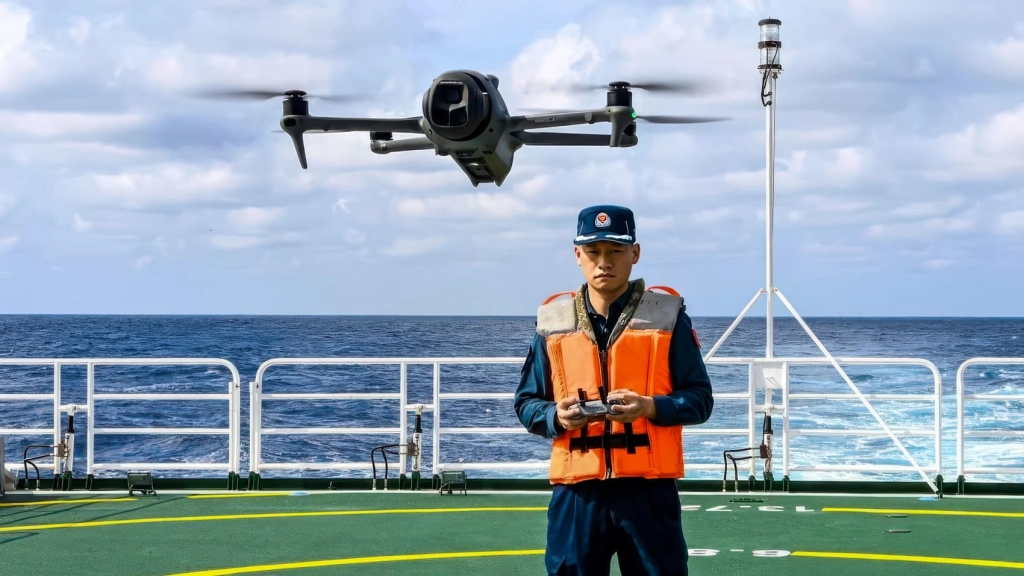 Photo credit: Zhai Yifan/Xinhua
Check out the Best Deals on Amazon for DJI Drones today!
China’s coastguard just gave us a rare window into how drones are shaping operations at Scarborough Shoal, and it did not come through a defense white paper or satellite imagery analysis.
It came through a Lunar New Year post.
Behind the festive tone was something far more strategic. Beijing is increasingly relying on uncrewed aircraft to patrol, document, and assert presence around the disputed reef in the South China Sea, as Xinhua reports.
And the details matter. That’s why he is using not only a Sony FX30, some Canon 90D, a DJI Avata 2, Mavic 3 Pro and Mavic 4 Pro.
Five Hours on Deck, One Drone in the Air
In the post, a coastguard officer described how he used his rest time to study video footage, learning how to reduce interference from wind, waves, and ship movement while filming tense stand offs with foreign vessels.
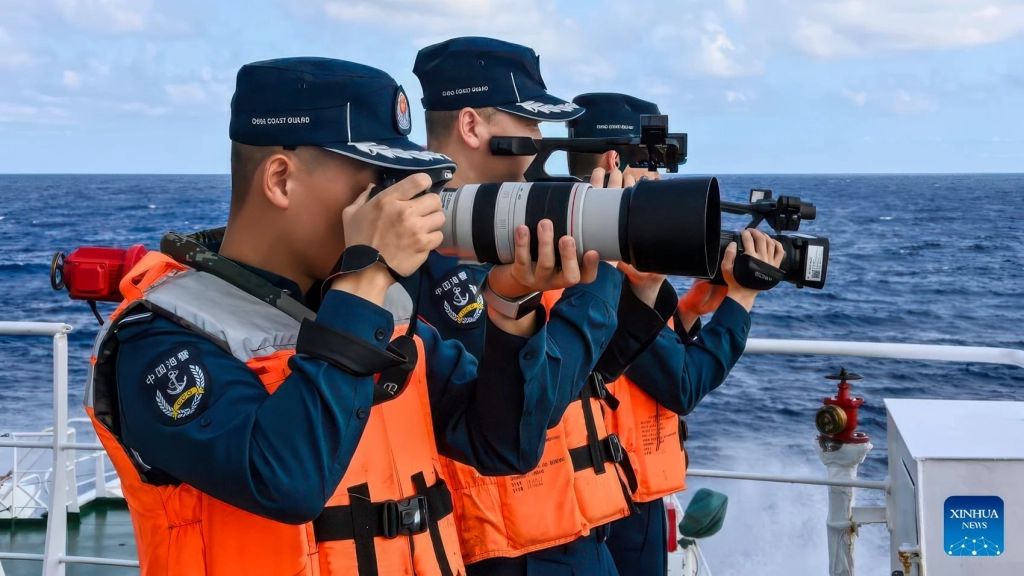 Photo credit: Zhai Yifan/Xinhua
This is not casual flying. This is operational refinement.
In one incident, the officer reportedly stood on the ship’s deck for five hours under intense sunlight to capture footage of a foreign vessel attempting to enter waters claimed by China. As his own ship maneuvered and the other vessel constantly changed position, he had to keep the drone stable and the camera locked in.
That is a floating, moving launch platform in open sea conditions. Anyone who has tried to fly from a boat knows how quickly things can go wrong.
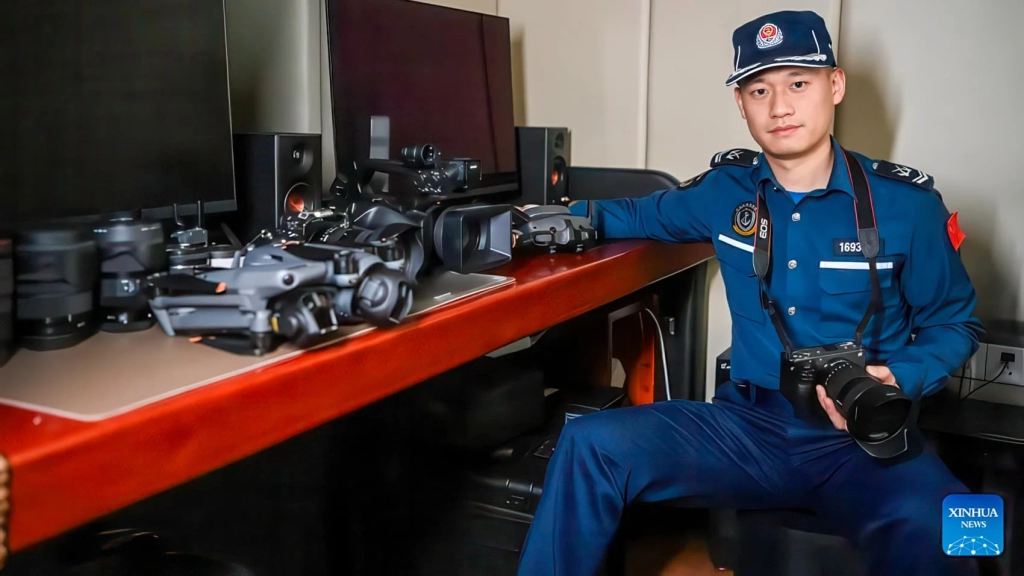 Photo credit: Zhai Yifan/Xinhua
Another new officer used his free time to learn drone and helicopter takeoff and landing procedures from senior colleagues. An experienced officer said he has been training younger personnel in drone operations so they can eventually pass vocational tests.
This is the key takeaway. Drone operations are no longer ad hoc. They are being standardized, taught, and formalized inside the Chinese coastguard.
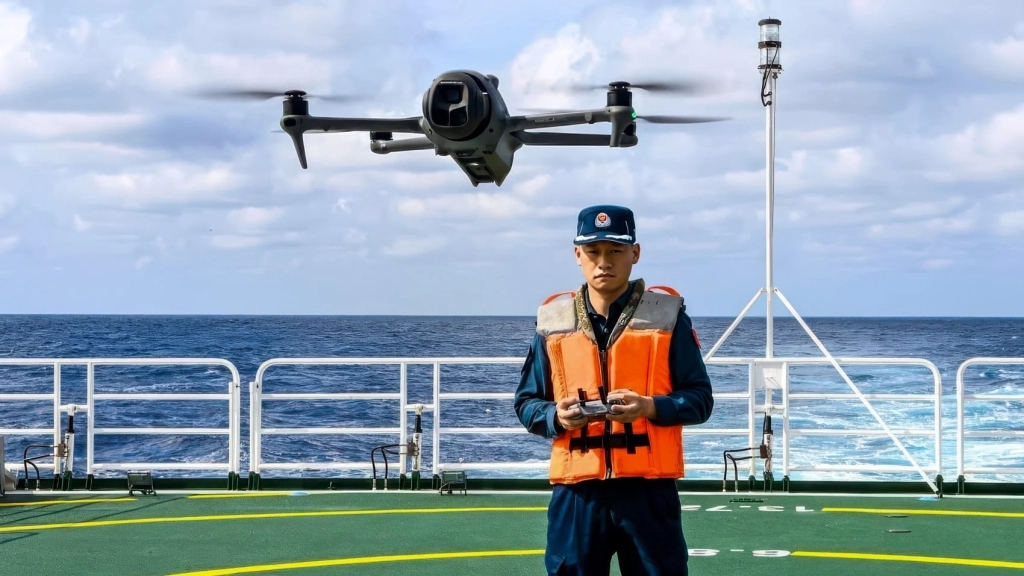 Photo credit: Zhai Yifan/Xinhua
That suggests long term integration, not temporary experimentation.
Geography Is Expensive, Drones Are Not
Scarborough Shoal, known in the Philippines as Panatag Shoal, remains a major flashpoint between Beijing and Manila. Both sides deploy coastguard vessels to patrol the surrounding waters.
But there is a geographic challenge for China. Its nearest major military base sits roughly 600 kilometers from the reef. Sustaining manned patrol aircraft and ships over that distance is expensive and resource intensive.
Drones change that equation.
Analysts believe rival claimants in the South China Sea are increasingly relying on aerial drones to compensate for the geographic and logistical limits of traditional aircraft and ships. Long endurance platforms can loiter for hours, monitor vessel movements, and document confrontations without risking pilots or escalating with manned overflights.
China has already deployed the GJ-2 in the South China Sea. The aircraft can reportedly fly for up to 20 hours with a standard payload, giving Beijing persistent surveillance capability over contested waters.
In November, a Wing Loong-10 with stealth features was spotted near Scarborough Shoal. A stealthy long endurance drone near a disputed reef is not just symbolic. It signals a layered surveillance strategy.
The United States has also stepped into the airspace. At Manila’s request, Washington deployed MQ-9A Reaper drones to the Philippines to support maritime domain awareness, according to United States Marine Corps Forces Pacific.
The GJ-2 and MQ-9A are broadly comparable in endurance and surveillance roles. That means the skies above the reef are no longer just watched. They are monitored by some of the most capable unmanned systems in service today.
The Gray Zone Above the Reef
Scarborough Shoal is a cluster of rocks and reefs. It is not large. But it sits at the center of a broader contest over maritime rights, fishing access, and strategic positioning in the South China Sea.
Last year, China approved the creation of a nature reserve on the reef. A year earlier, Beijing formalized its territorial claim after the Philippines passed legislation outlining its own competing claim. Both moves drew opposition from Manila.
In this environment, drones become more than surveillance tools. They are instruments of narrative control.
Who recorded the encounter.
Who documented the maneuver.
Who released the footage first.
Persistent unmanned surveillance allows countries to maintain presence without constantly deploying large manned assets. It reduces cost, lowers immediate political risk, and keeps tensions in the gray zone rather than pushing them into open conflict.
China’s uncrewed submarines and aircraft are believed to focus on routine patrol missions. Routine is important. Routine normalizes presence. Presence reinforces claims.
For drone observers, this is another example of how unmanned systems are becoming central to maritime disputes worldwide. The South China Sea is no longer just a naval chessboard. It is an aerial one.
And drones are the pieces that never seem to leave the board.
DroneXL’s Take
The Lunar New Year post was not just holiday content. It was a signal.
China’s coastguard is professionalizing drone operations at Scarborough Shoal, building training pipelines, endurance capability, and persistent aerial coverage over a disputed reef 600 kilometers from its nearest major base.
At the same time, the United States and the Philippines are deploying their own high endurance platforms into the region.
The result is a quiet but constant drone presence above one of Asia’s most contested maritime flashpoints.
In the South China Sea, persistence is power. And drones are built for persistence.
Photo credit: Zhai Yifan/Xinhua