
AUVSI Expands Its Lobbying Playbook From Drones To Robots With New Capitol Hill Partnership
 Photo credit: AUVSI
Check out the Best Deals on Amazon for DJI Drones today!
The same organization that spent the last two years pushing to ban Chinese drones from U.S. skies now wants to shape federal robotics policy. The Association for Uncrewed Vehicle Systems International (AUVSI) launched the Partnership for Robotics Competitiveness (PfRC) on Capitol Hill this week, bringing together Congressional leaders and robotics executives in the Cannon House Office Building. The initiative calls for a National Robotics Strategy covering workforce development, supply chain security, and standards for physical AI.
If the name sounds familiar, it should. AUVSI ran the same play in September 2023 with its Partnership for Drone Competitiveness, a coalition that publicly claimed to support a fair transition away from Chinese drones while privately backing immediate bans in states like Utah and Florida.
- The Development: AUVSI launched PfRC alongside a white paper outlining a National Robotics Strategy, with support from Boston Dynamics, Ghost Robotics, Apptronik, Forterra, Applied Intuition, Intrinsic AI, Teradyne, and Ouster.
- The Legislative Tie-In: Rep. Jay Obernolte (R-CA) introduced the National Commission on Robotics Act the same day, a bipartisan bill co-sponsored by Rep. Jennifer McClellan (D-VA) and Rep. Bob Latta (R-OH) to establish an 18-member commission evaluating U.S. robotics competitiveness.
- The Pattern: AUVSI President & CEO Michael Robbins and Sen. Ted Budd (R-NC), both central figures in the drone competitiveness push, appeared at the robotics launch alongside Boston Dynamics VP Brendan Schulman.
AUVSI’s robotics push mirrors its drone competitiveness playbook
The Partnership for Robotics Competitiveness is structurally identical to AUVSI’s drone-focused effort. It is an industry coalition led by AUVSI that frames U.S. technological leadership as dependent on coordinated federal policy, supply chain security, and reducing reliance on foreign competitors. The white paper released alongside the launch covers workforce development, industrial resilience, and standards for emerging technologies.
“The age of autonomy and advanced robotics is here, and dominance in this industry will determine who leads the next industrial revolution,” said Michael Robbins. “That’s why America must get Robot Ready with a National Robotics Strategy to strengthen our industrial base, secure our supply chains, and accelerate innovation.”
The language is almost interchangeable with what Robbins said when launching the drone partnership in 2023: that a strong domestic industry is a “strategic imperative” and that the U.S. must “level the playing field” against foreign-subsidized competition. Back then, “foreign-subsidized competition” was code for DJI. This time, the target is broader: Chinese robotics firms like Unitree, AgiBot, and UBTech that are rapidly scaling humanoid robot production.
The competitive context is real. China invested roughly $7.9 billion across 610 robotics deals in 2025, nearly triple the 2024 figure. By mid-2025, Chinese robotics venture investment exceeded U.S. levels by 42%. Chinese firms are already shipping humanoid robots at scale, with companies like UBTech targeting 5,000 units in 2026 and AgiBot celebrating its 5,000th humanoid off the production line.
The National Commission on Robotics Act adds a legislative framework
The National Commission on Robotics Act would direct the Department of Commerce to create an independent, temporary commission of 18 experts in robotics and robotics applications. Members would be appointed by Congressional leadership from both parties and by the President. The commission would examine domestic and international developments, workforce challenges, supply chain risks, manufacturing competitiveness, and the role of robotics in national security.
“Advanced robotics and physical AI are critical to America’s future economic strength, industrial resilience, and national security,” said Rep. Obernolte. He is also co-chair of the Congressional Robotics Caucus, which relaunched in mid-2025 with bipartisan support.
The bill requires an interim report within one year and a final report within two years, with recommendations for Congress, the White House, and relevant federal agencies.
Boston Dynamics VP Brendan Schulman called it “the first piece of federal legislation in support of the growth and success of the robotics industry in the United States.”
Sen. Ted Budd (R-NC), who also backed AUVSI’s drone partnership in 2023, voiced support:
“The United States is leading the charge in redefining the potential of physical AI and robotics.” He added that he is working with colleagues and the Trump administration “to refine federal policy that creates a national robotics framework.”
The industry panel reveals AUVSI’s defense-heavy coalition
The Capitol Hill event featured two industry panels. The first focused on Economic Competitiveness and Industrial Resilience, with executives from Boston Dynamics, Intrinsic AI (an Alphabet company), Apptronik, and Teradyne. The second panel covered Defense, National Security, and Cyber-Physical Resilience, with leaders from Forterra, Applied Intuition, and Ghost Robotics.
The panel composition tells a story. Half the participants have direct defense and military contracts. Forterra builds autonomous ground vehicles for the U.S. military. Ghost Robotics makes quadruped robots used by the Department of Defense. Applied Intuition provides simulation software for autonomous military systems. Even Boston Dynamics, known for its viral robot videos, has long-standing ties to DARPA and military research.
Forterra’s Steve Rubright made the defense angle explicit: “The challenge today is policy and acquisition systems that were built for a different time.” He pushed for policies that “increase rapid fielding and greater use of trusted commercial technologies.”
Applied Intuition’s Nicholas Kazvini-Gore framed it in national security terms:
“Physical AI is the foundation of America’s economic strength and national security. To stay competitive, we need a coordinated approach that accelerates the safe deployment of software-defined systems and strengthens domestic manufacturing.”
Brendan Schulman brings drone policy experience to the robotics table
One familiar name in the PfRC coalition is Brendan Schulman, Vice President of Policy & Government Relations at Boston Dynamics. Schulman spent six years as DJI’s VP of Policy & Legal Affairs, where he played a major role in shaping drone regulations across the United States and abroad. He helped defeat hundreds of anti-drone state bills, shaped Remote ID policy, and built the framework that allowed commercial drone operations to scale.
When Schulman left DJI in September 2021, he described Boston Dynamics as offering “the same sense of wonder and opportunity” he had experienced with drones. His focus shifted to ground-based robotics, but his core mission stayed the same: getting ahead of regulation before it stifles innovation.
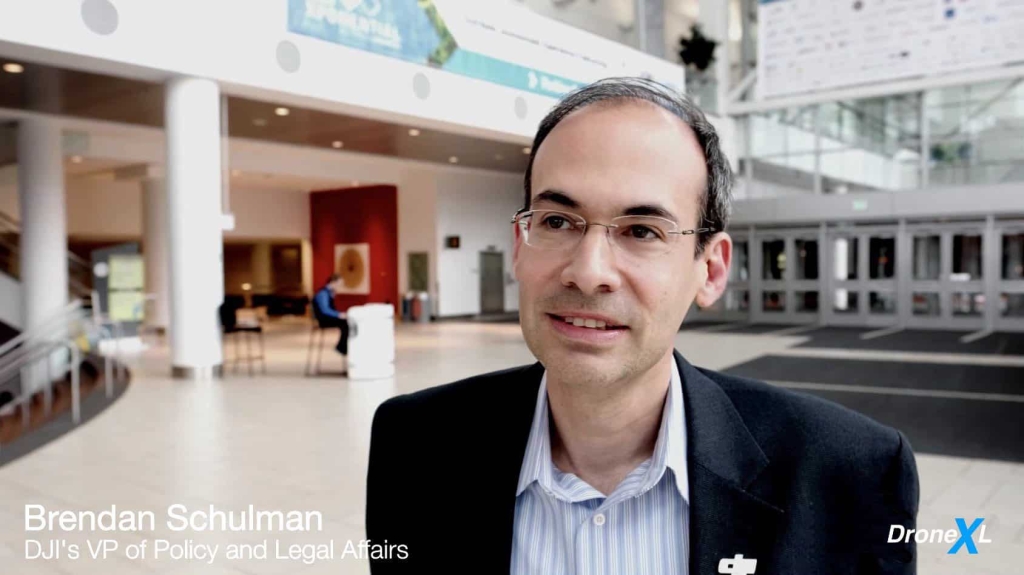 Photo credit: DroneXL
In a 2023 interview, Schulman described his career as driven by “advocating for the technology, for the people who would come to use and benefit from it.” That philosophy is visible in his PfRC endorsement. He called the National Commission on Robotics Act “the first piece of federal legislation in support of the growth and success of the robotics industry in the United States” and warned that the window for proactive policy is narrowing as “AI dramatically accelerates the capabilities of robots, and as foreign competition intensifies.”
Schulman’s experience with the drone industry’s regulatory battles gives him a perspective that few in the robotics space have. He saw firsthand what happens when policy falls behind technology. Whether PfRC applies those lessons constructively or follows AUVSI’s more aggressive lobbying tendencies will be worth watching.
DroneXL’s Take
We have seen this movie before. AUVSI launched its Partnership for Drone Competitiveness in September 2023, and within months, DroneXL uncovered documents showing the organization privately supported immediate DJI drone bans in Utah while publicly claiming it only backed gradual transitions. The Law Enforcement Drone Association called out AUVSI’s “overt gaslighting” on drone legislation. Pilot Institute, 51 Drones, and other major voices in the drone community pulled out of AUVSI’s annual conference altogether.
Now AUVSI is running the same strategy for robotics. The rhetoric is identical: “secure supply chains,” “level the playing field,” “trusted commercial technologies.” These phrases sound reasonable in isolation. But AUVSI’s track record shows that “leveling the playing field” means lobbying to ban the foreign competition, not making American products better or cheaper.
The China competition angle is real. Beijing poured nearly $8 billion into robotics ventures in 2025 alone, and Chinese firms are shipping humanoid robots while American companies are still running demonstrations. That gap is worth addressing. But addressing it through protectionist lobbying rather than actual innovation is exactly what happened with drones, and the result was that American drone pilots ended up with fewer options at higher prices.
The defense-heavy composition of PfRC’s panels is telling. This is not a coalition built around consumer robotics or small business automation. It is built around companies that sell to the Pentagon. There is nothing wrong with defense innovation, but let’s be clear about what this initiative is: a lobbying vehicle for defense contractors who want federal procurement policies tilted in their favor, wrapped in the language of national competitiveness.
Watch what happens over the next 6 to 12 months. If PfRC follows the drone playbook, expect state-level bills restricting Chinese-made robotics components, followed by federal legislation with “transition periods” that function as de facto bans. AUVSI will claim it doesn’t support outright bans. The documents will tell a different story.
One thing I’ll give them credit for: the bipartisan approach works. Obernolte (R-CA), McClellan (D-VA), Budd (R-NC), and Latta (R-OH) span the political spectrum and represent districts with real manufacturing and tech interests. The National Commission on Robotics Act is a reasonable piece of legislation on its own merits. My concern is not with the commission. It is with who fills the seats and whose interests they represent when the recommendations start flowing.
Editorial Note: AI tools were used to assist with research and archive retrieval for this article. All reporting, analysis, and editorial perspectives are by Haye Kesteloo.