
FAA NOTAM Bans Drone Flights Near Moving Federal Assets, Prompting Civil Liberties and Operator Concerns
FAA’s ‘mobile’ NOTAM raises concerns for drone operators
By DRONELIFE Features Editor Jim Magill
Civil liberties advocates and media representatives are raising concerns that a sweeping new FAA security policy, designed to protect federal law enforcement agents and their assets from potential harm from rogue drones could impinge on the constitutional rights of legitimate drone operators.
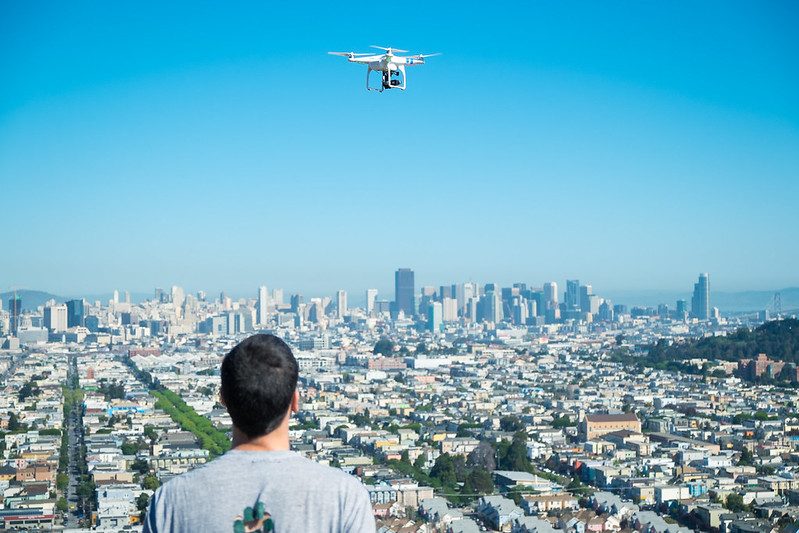
Image credit: Mapbox, CC by 2.0
In an unusually broad Notice to Air Missions (NOTAM), which the FAA issued on January 16, the agency prohibits flying drones above or near federal military or law enforcement personnel or their vehicles. Unlike the type of temporary flight restriction (TFR) that the FAA typically issues to protect the airspace around specific events, such as the Super Bowl or VIP visits to an area, the NOTAM does not have a specific start and end date and does not define a specified geographic area.
And because it covers the airspace above and around moving vehicles, such as those deployed by Immigration and Customs Enforcement (ICE) officers conducting immigration raids, the area of restricted airspace cannot be communicated to UAV operators in advance. The FAA instead warns legitimate drone operators to be aware of when such government law enforcement activity is taking place in their area and to take steps to avoid it.
Jay Stanley, a senior policy analyst with the American Civil Liberties Union, said the “extremely broad and vague” nature of the NOTAM makes the policy ripe for abuse by law enforcement personnel seeking to curtail the constitutional rights of legitimate drone pilots.
“It raises questions about the fairness of its application and about whether it leaves room for journalists and any individual acting as a journalist to use drones without being subject to the arbitrary authority of the government to stop them,” Stanley said in an interview with DroneLife.
He cited allegations that federal immigration agents in Minneapolis have attempted to stop citizens from filming their enforcement activities and worried that the new restrictions would create no-recording zones in the sky.
“There’s every reason to think that they will use this in similar ways, not for legitimate safety purposes, but to stop people from recording them,” he said.
According to the NOTAM, “all unmanned aircraft are prohibited from flying within a stand-off distance of 3,000 feet laterally and 1,000 feet above” facilities and mobile assets of “the Department of Defense (DOD), Department of Energy (DOE), and Department of Homeland Security (DHS), including vessels and ground vehicle convoys and their associated escorts.”
The prohibitions in the NOTAM carry strong penalties for UAV operations found to be in violation, including the threat of federal criminal prosecution. “And the FAA may take administrative action, including imposing civil penalties and revoking FAA certificates or authorization to operate.”
In addition, UAS operators whose drones are deemed to pose a credible safety or security threat to protected personnel, facilities or assets face the threat of counter-UAS mitigation efforts. “Mitigation may result in the interference, interception, seizure, damaging or destruction of unmanned aircraft deemed to pose a credible safety or security threat to protected personnel, facilities or assets,” the NOTAM states.
This NOTAM expands on and replaces an earlier prohibition to UAS operators, advising them to avoid flying in close proximity to facilities and mobile assets of the DOD and the Department Of Energy (DOE), “in the interest of national security.” It included in its description of mobile assets Coast Guard vessels.
The more recent NOTAM widens the special security instructions (SSI) of the earlier NOTAM to include facilities and assets of the DHS and its agencies, such as ICE and Customs and Border Patrol (CBP), and expands the definition of mobile assets to include “ground vehicle convoys and their associated escorts.”
Organizations representing commercial UAV operators have expressed concerns that the broad flight restrictions could impede the operations of legitimate drone pilots and called for more disclosure from the FAA of the details of the restrictions.
“The Commercial Drone Alliance is inquiring with federal regulators to ensure authorized commercial and public safety drone operators have the information they need to remain compliant, but in the meantime, operators should be aware of these new restrictions and plan accordingly,” the CDA said in a post on LinkedIn.
In addition, Stanley said the new restrictions would make it almost impossible for law-abiding drone pilots to avoid running afoul of the flight restrictions.
“I don’t understand how anybody is supposed to comply with this without advanced notice of the areas that they’re not supposed to fly in,” he said. “It basically seems to me that anybody who’s operating a drone, if CBP decides to drive under you, you’re suddenly vulnerable to a $10,000 fine and seizure of your drone.”
He added that the counter-UAS authorities that the NOTAM gives to federal agencies could be used against legitimate drone pilots operating in any area that becomes a site for federal immigration raids. “They’ll use this as a catchall authority to take down any drone they want to, anytime they want to.”
Press group raises concerns
In an email statement, Mickey Osterreicher, general counsel of the National Press Photographers Association (NPPA), said the restrictions in the NOTAM make it harder for the press to report on events in news hot spots such as Minneapolis.
“While the National Press Photographers Association (NPPA) understands the FAA’s mandate to ensure aviation safety and support legitimate national security interests, this sweeping extension of no-fly space raises serious concerns for journalists and news organizations that depend on aerial footage to report on matters of public concern,” he said.
Osterreicher said a broad-based TFR that the FAA had imposed in October over a large area in the city of Chicago had a dampening effect on press freedom in that city and added that the new NOTAM is even more restrictive for journalists who use drones in their reporting.
He said those earlier restrictions in Chicago did not apply to crewed aircraft, which meant that news organizations could still collect newsworthy images using helicopters and fixed-wing aircraft. By contrast, the new NOTAM’s “1,000-foot vertical limit applies to all unmanned aircraft in proximity to DHS mobile assets, but would similarly affect lower-altitude operations by journalists in crewed aircraft if those aircraft are tracking or documenting the same events in shared airspace,” he said.
Osterreicher called on the FAA to establish guidelines for journalists wishing to use drone to report on newsworthy events involving federal law enforcement officers.
“Without clear guidance or mechanisms for accredited media to secure timely waivers, journalists and independent documentarians may be unable to safely document enforcement actions and public demonstrations in real time,” he said. “This is particularly pressing at a moment when federal immigration operations and local responses in Minneapolis and other communities continue to draw intense public scrutiny.”