
Caltech’s X1 Robotic Duo Has A “Hybrid Drone” That Can Crawl, Drive, And Fly
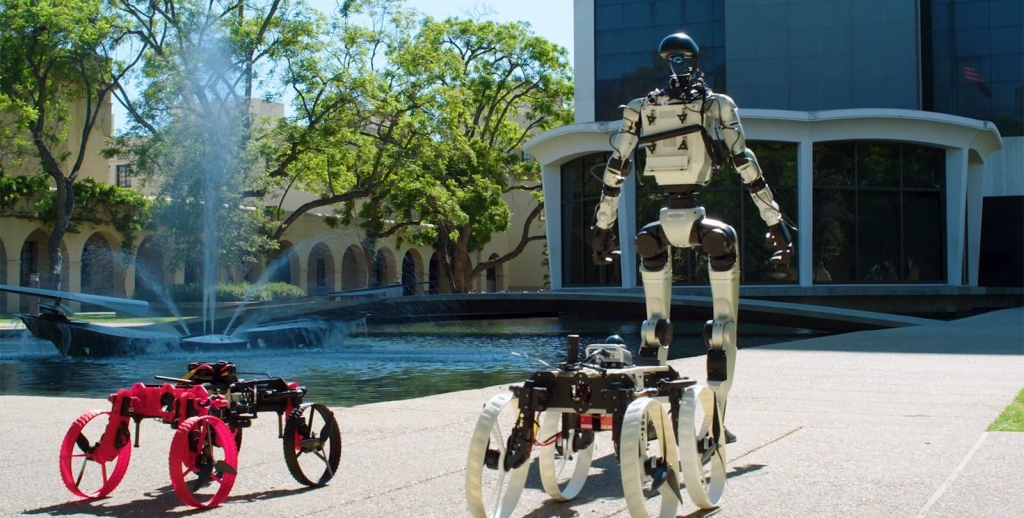 Caltech X1 Robot Hybrid Drone Duo | Photo Credits: Caltech
Amazon Drone Deals: DJI Mini 5 Pro Fly More Combo with DJI RC2 now for $1,099!
Caltech has teamed up with the Technology Innovation Institute (TII) to create a robotic symbiosis between a Unitree G1 humanoid robot, and their own hybrid drone prototype – the Morphobot M4.
This autonomous duo is able to carry out safety-sensitive operations without any human interaction. The G1 carries M4 to a good launch point, deploys it off its back, and then continues on foot while the M4 hybrid drone takes the faster route and adapts its movement style as the terrain changes.
 Caltech’s YouTube video showing a simulated emergency scenario with the X1 Hybrid Drone/Robot Duo
Hypothetically, humans wouldn’t even need to bring rescue equipment to a remote or dangerous area if the X1 is able to transport it there remotely. If the mission doesn’t involve the M4 being mounted on the G1 robot, the spot on its back could be repurposed in the future with modular payloads.
Locomotion plasticity is a huge advantage of the M4. Its ability to seamlessly switch between rolling, flying, and crawling makes it the most well-rounded hybrid drone I’ve seen developed to date, and its potential for helping save lives in the future is
What is the X1 Actually Demonstrating?
“Right now, robots can fly, robots can drive, and robots can walk. Those are all great in certain scenarios. But how do we take those different locomotion modalities and put them together into a single package…?”
- Aaron Ames, Caltech CAST Director
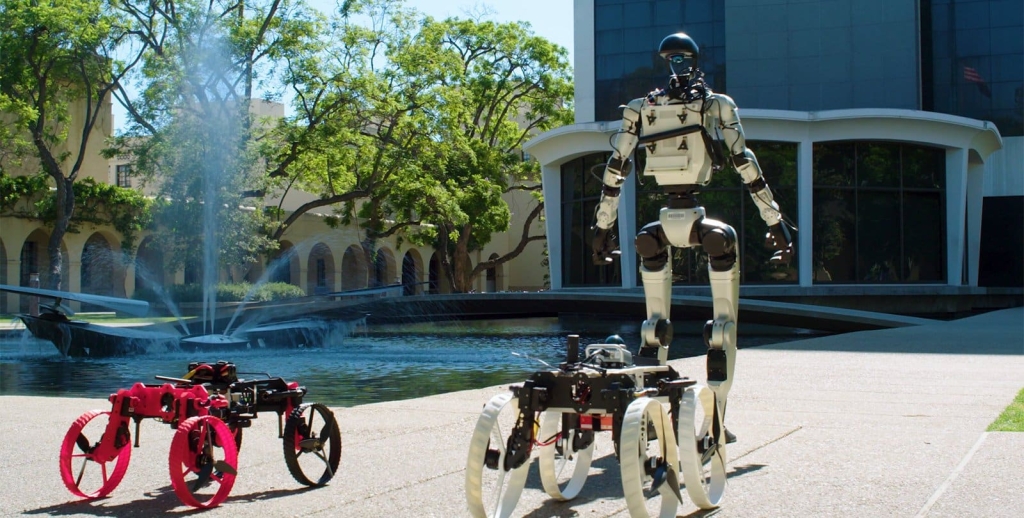 Caltech X1 Robot Hybrid Drone Duo | Photo Credits: Caltech
Caltech even laid out a great hypothetical in the above video: the G1 begins at Gates-Thomas Laboratory, moves through Sherman Fairchild Library, then deploys the M4 outside. The M4 then encounters a body of water it needs to traverse. Instead of trying to find a way around, it selects the path of least resistance and switches from driving to flying mode in order to complete the mission.
The Unitree G1: Why a Humanoid Belongs in the Group
The walking half of the duo is an off-the-shelf Unitree G1 that Caltech modified so it could carry M4 “as if it were a backpack.” The entire point of the G1 transporting the M4 instead of a different robot is simple: the G1 can move through spaces designed for humans.
Stairs, doorways, curbs, tight indoor corridors, clutter, and uneven transitions are exactly where a lot of ground robots start to look fragile. A drone can bypass some of it, but drones also run into their own limits indoors and in confined spaces. Personally, I’ve heard from a local sheriff that their robot meant to open doors (that uses tank-style treads) failed to climb a simple flight of stairs, and that unit supposedly cost over $30,000.
Unitree lists the G1 at roughly 4.25 feet tall, and about 70 Lbs. with its battery. In other words, it is compact enough to move in human environments and capable enough to act as a mobile platform for sensors, payloads, or in this case, another robot.
The Unitree G1 is not the “fast” part of X1. It is the part that gets the system out of the starting gate in a human-built environment, and it is the piece that keeps the overall team functional when wheels are useless.
The M4 Morphobot: the Hybrid Drone That Refuses To Stop Once it Lands
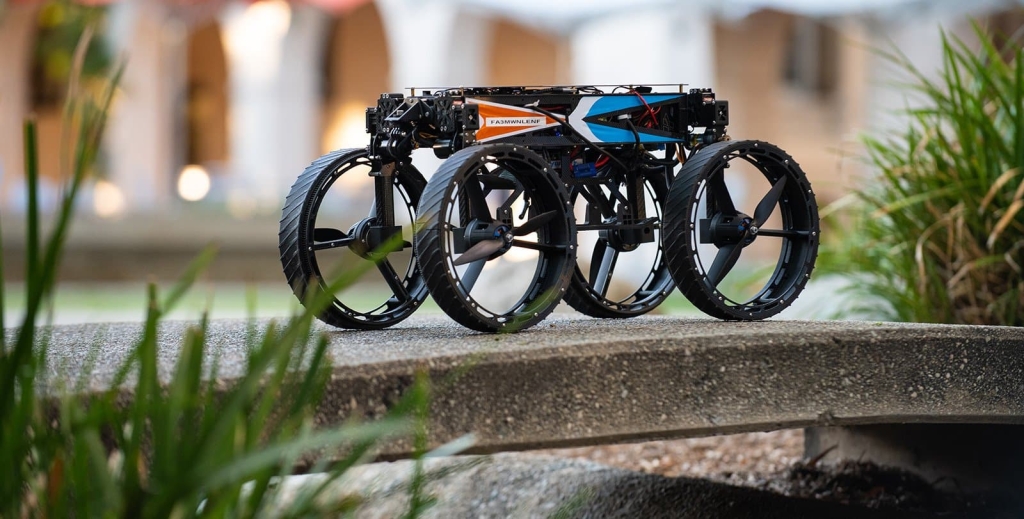 Caltech M4 Morphobot Hybrid Drone | Photo Credits: Caltech
Caltech’s M4 is where drone folks should really pay attention. The Morphobot is built around “appendage repurposing,” meaning the same hardware can act as wheels, legs, arms, and thrusters depending on what the robot needs in that moment.
While it’s not publicly stated, the M4 appears to use a DJI Matrice 4 Series Obstacle Sensing Module, which utilizes LiDAR and radar simultaneously, enabling the M4 to “see” even in zero-visibility conditions (like a burning building).
In the Nature Communications paper describing M4, the team lists a whole menu of modes: flying, rolling, crawling, crouching, balancing, tumbling, scouting, and “loco-manipulation.” They also show the M4 traversing inclines up to 45 degrees in balancing mode and using onboard computers and sensors to autonomously choose modes in unstructured environments.
Where this gets exciting, fast
The obvious headline application is search and rescue, and the M4 paper directly calls out disaster response as a scenario where multi-modal mobility matters. But the same logic applies to a bunch of drone-adjacent work:
- Industrial inspections where you want a quick aerial sweep, then ground-level close-ups
- Facilities and infrastructure where you have indoor transitions, stairs, and tight access points
- Post-incident response where drones are useful for initial awareness, but ground mobility is needed to actually move through the scene
X1 is not a finished product. It is a proof-of-concept that shows how quickly the “drone” category is slowly bleeding back into general robotics.
DroneXL’s take
Admittedly, the X1 looks like a Transformer meme waiting to happen, but the concept is solid.
If drones are going to keep pushing deeper into public safety and complex industrial environments, (which they will) “fly to a point and hover” is not enough. The future is systems that finish the job when flight stops being the best option.
With the recent ban of DJI and other foreign-made critical drone components, the US will soon be facing several years of regression within its public safety sector. I personally know of at least three law enforcement departments currently using DJI drones, and they can’t afford to replace them, much less with more expensive domestic alternatives. In order to fill that gap, we’ll need more innovators like the teams at Caltech and TII to keep our aviation industry moving in the right direction.
The most important takeaway from the X1’s debut is not flying over a turtle pond, it’s what happens after the drone lands. When the robot converts to a ground vehicle and keeps moving, the system begins to take the shape of what it may one day be – a fully autonomous emergency-response vehicle.