
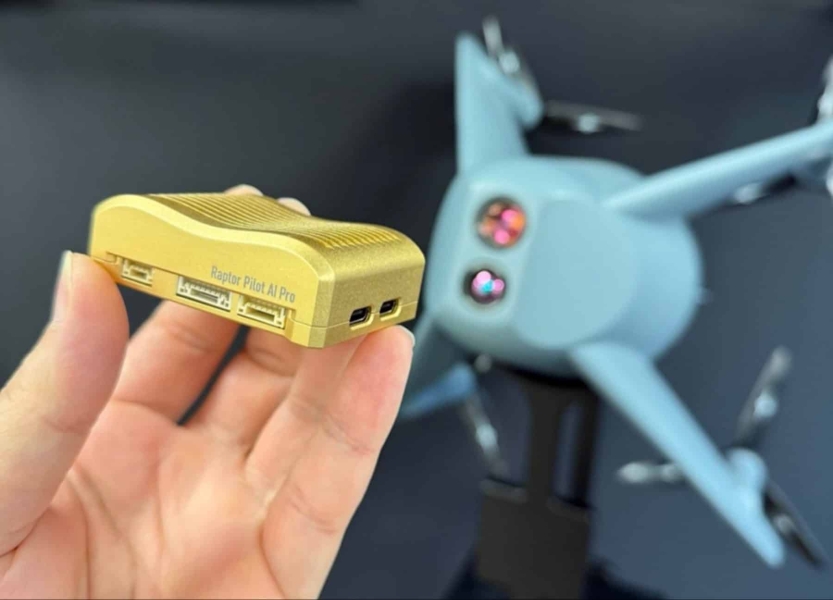
 Raptor AI Pro AI-enabled Autopilot Module | Photo Credits: London Defence R&D
Check out the Best Deals on Amazon for DJI Drones today!
London Defence R&D recently unveiled their Raptor Pilot AI Pro, a 100g AI autopilot unit that is capable of using visual and inertial systems to reach its target, even if it doesn’t have an external control link.
This AI autopilot module combines flight control and onboard vision processing into a solid, unified package. The Raptor Pilot AI Pro’s appeal will continue to grow as drones continue to dominate battlefields across the globe: bolt this thing onto a platform, give it a camera feed, and it can detect and track targets in real time, without needing a separate control link.
As their name suggests, London Defence R&D does not dabble in consumer drone equipment like DJI or HoverAir. You won’t be able to stop through a local hobby shop to snag a Pilot AI Pro module any time soon, even if the form factor indicates otherwise (seriously, this looks like something I’d use in the classroom).
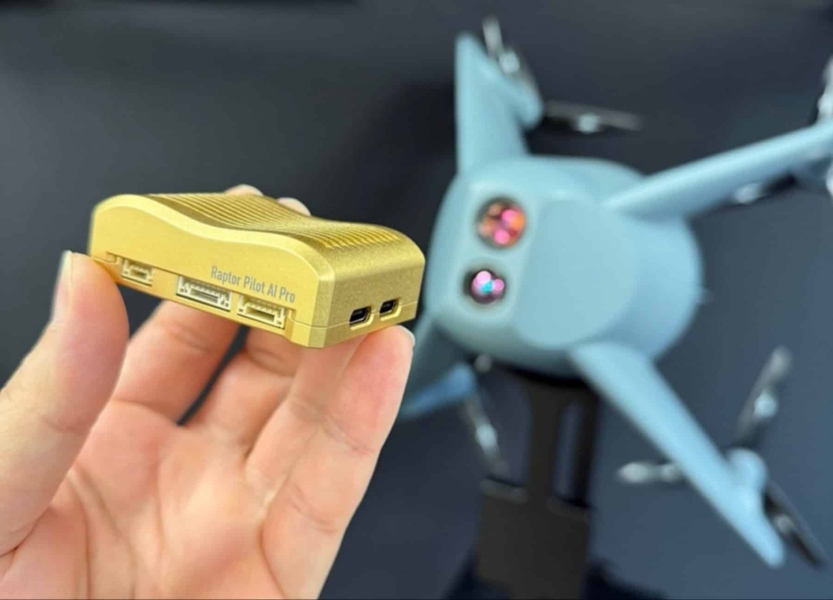 Raptor AI Pro AI-enabled Autopilot Module | Photo Credits: London Defence R&D
What are the Specs?
According to a report by NextGenDefense, the following specs appear to be set-in-stone:
- Weight: ~100 g (about 3.5 oz)
- Physical size: roughly 4 × 5 × 2 cm
- Power input: 6 to 28 V DC
- Flight controller: STM32F405 (a very common, well-understood MCU family in the drone world; F405 stacks are typically used in hobby/professional-level FPV builds, just usually not paired with this kind of onboard computer)
- Compute: quad-core CPU @ 2.4 GHz
- Video processing: Full HD 1920×1080 at 30 fps for detection and tracking
- Sensors listed as integrated: IMU + barometer, with sensor fusion that can keep operating when GNSS is degraded
- Interfaces (broadly claimed): I2C, Ethernet, CAN, UART, PWM, USB, plus Wi-Fi and Bluetooth 5.0
- Weatherproofing: IP65
That’s a pretty impressive feature list for a payload as small as an ArduPilot flight controller. However, I’m a bit skeptical, and I’m interested in seeing the onboard AI’s detection capabilities in real-time, not just on paper.
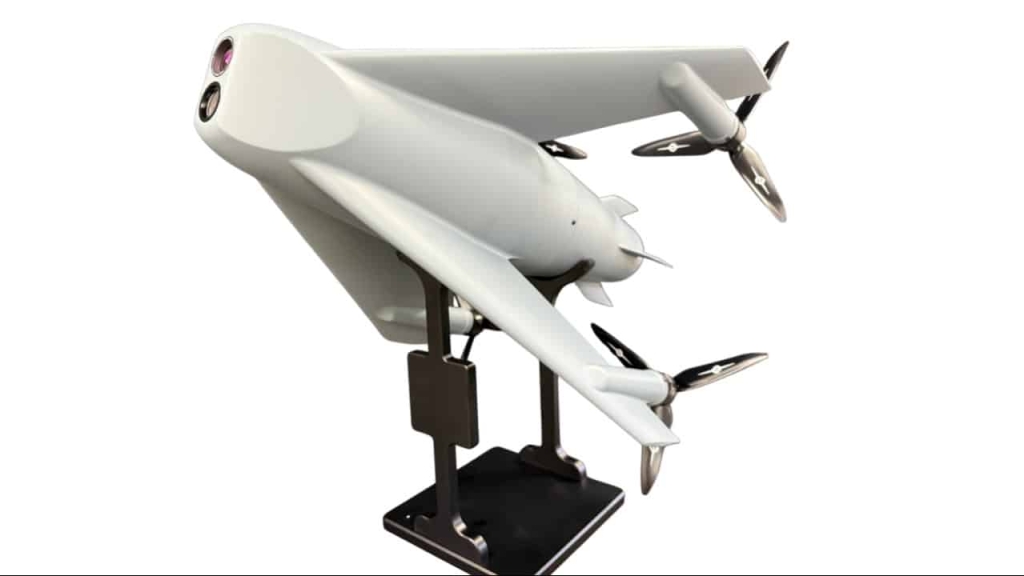 Raptor Mini Interceptor Drone with Raptor Pilot AI Pro Autopilot Hardware Stack | Photo Credits: London Defence R&D
What is a “Unified” hardware stack?
Most FPV, DIY, and commercial drones have a “stack” that is made up of several different pieces. The parts of a stack we’ll focus on are the:
- Flight controller (running ArduPilot, Betaflight, iNAV, etc…)
- Companion computer (Jetson, x86, etc.)
- Video transmission system (VTX) and its accompanying camera
London Defence R&D has collapse the stack into one module so that the control loop and video loop are closer together, which means less weight, wiring, delay, and points of failure.
Also, if you’re looking for an interceptor drone like a Baby Raptor or Raptor XL, you won’t want a half-assed science project that barely flies a straight line; you want something that is accurate, quick, and easy to use.
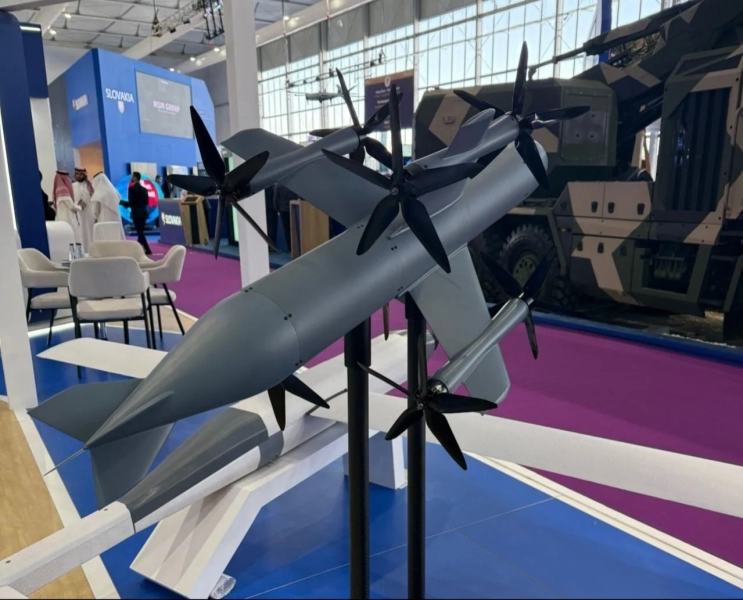 London Defence R&D’s Raptor XL Drone, equipped with the Raptor Pilot AI Pro Autopilot module | Photo Credits: defence-blog.com
What’s missing from their public info?
Supposedly, their system runs at “1080p at 30 fps,” which would be impressive in 2018 for a drone’s onboard camera, but it leaves a lot to be answered. My questions are:
- What camera, lens, and latency could be expected?
- What “tracking” actually means:
- Are these operator-assisted boxes for a human to confirm, or
- True autonomous tracking and mitigation
- Clarification on GPS-denied operations:
- “Works when satellite signals are degraded” can mean anything from “still flies stable” to “still navigates meaningfully.” Vision-aided navigation is real, but it is heavily environment-dependent.
- How does it integrate with Command-and-control (C2) links and external sensors?
- What protocols can it accept?
- Does it support external RGB, IR, or radar sensors?
- How does target handoff occur between the onboard AI and an external link?
- Durability
- How will these units hold up to EW equipment, physical damage, or signal degradation?
DroneXL’s Take
This autopilot module looks sweet. A 100-gram, unified control/vision processing stack is exactly the direction I believe drones will begin trending toward in the coming years. Less wiring, and less hours prototyping in CAD are always welcome in the UAS industry.
While it’s great getting to see the military-side things getting some much needed attention (especially for the US-domestic market), I do hope to see these kinds of advancements gain popularity among the consumer side too. Getting an AIO board for a tinywhoop is nice, but if we could get a flight controller that had ESCs, VTX, C2 module, camera, and multiple inputs all in one tiny package for a 7″ build, that would be amazing.
If you’ve ever worked with drones before, let me know what you think about this thing, and if you could see an AI-enabled payload like this being useful for consumer customers in the future.